post

Mark’s Neologisms #2

“Never trust a computer you can’t throw out the window.”–Steve Wozniak

computus interruptus— n. the spontaneous unwanted shutdown of a program or app on a computer, tablet or smart phone.


computus interuptus

We’ve all been there.   You’re just about done with the spread sheet, or you just found the eatery you want on Yelp, or you are on the verge of a record score on some dumb game.  And then you click or tap or swipe and the program or app shuts down.  Poof.  It’s gone.  Dear Mr. Hawking, please tell us which black hole it fell into and how do we get it back?  Or do we do the Wozniakian thing and throw the device out the window?  Oh look, I just created another neologism.  Wozniakian.  Isn’t this fun?
 

post

New Feature: Mark’s Neologisms

” I can’t wait to go home and wash all those socks.”–Julianne Moore

Let’s face it:  daily life in the new millennium is full of any number of experiences that, well, there is just no word or words to describe.    Enter Mr. World’s Most Cluttered Mind to come to the rescue.  Herein lies the ultimate descriptionary for everything you wanted to curse out but had no easy descriptive way to do so.  We’ll start, though, with a low tech dilemma, rooted in the 20th century.

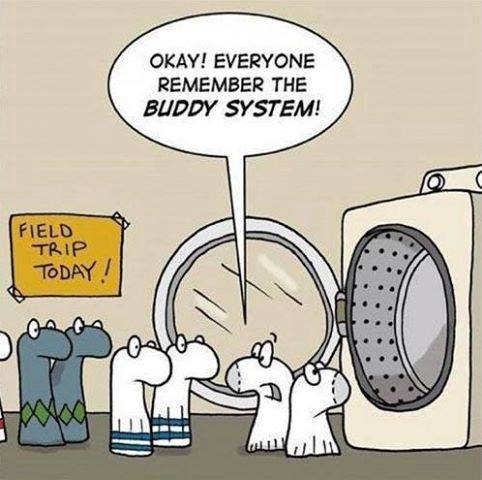
Dysoxia–n.  The anxiety caused by inability to match socks when they come out of the wash.

Somebody is not following directions.

Somebody is not following directions.  (Cartoon attribution unknown)

We’ve all experienced it.   You get to the end of folding a basket of clean clothes, and there they are:  two socks that don’t match.  Even worse, maybe there is an odd number of socks left with no matches.  Three. Five. (1083)+1.**    There are any number of theories to explain this phenomenon.   The socks are alien beings, and the missing one has reported back to its home planet.  Socks are the larval form of wire hangers.  A more scientific approach is my theory of frequent wash color drift:  as socks get washed over and over, the color of each sock fades at different rates over time.   This causes subtle mismatches which, when compounded by folding several pairs,  may leave you with two socks at the end that are far apart in hue.   How does this explain being left with an odd sock at the end?  My guess is somewhere one sock disintegrated and its remains will be found in the lint drawer.

Please feel free to share your theories, and to suggest subjects for future editions of Mark’s Neologisms.  Oh, and my advice to Ms. Moore?  You’re a rich movie star.  Don’t ever wash socks,  you can afford to wear them once and throw them away.

** In case you were wondering how many socks (1083)+1 is–it is probably enough to fill the entire visible universe.  And none of them would match.


post

Cosmic Quote #13 (redux)

“The main reason Santa is jolly is he knows where all the bad girls live.”–George Carlin

Hmmm.I Wonder what he's looking for...(www.savagechickens.com, click for link)

Hmmm.I Wonder what he’s looking for…(www.savagechickens.com, click for link)

I knew there was a reason I was jealous of the guy.  I also now know what he is doing the other 364 days while the elves are making all the toys.  At any rate, this non-theistic, almost-atheist existentialist wishes you a Merry Christmas, Happy Hanukkah, Season’s Greetings, happy pagan winter solstice, or whatever it is you celebrate.

post

Cosmic Quote #47

“The problem with quotes on the Internet is that you never know if they are genuine”–Abraham Lincoln

A little nonsense now and then, is cherished by the wisest men.

A little nonsense now and then, is relished by the wisest men.

Be assured that all of the Cosmic Quotes on this site are genuine.  As in, “I have genuinely researched all of them–on the Internet.”  This one included.


post

Google This! Search Term Haiku #5

“If it isn’t on Google, it doesn’t exist.”–Jimmy Wales

 Not that it has anything to do with this post, but I have to start with something:  reading the above quote, it also occurs to me that if something is ON Google, it exists whether it wants to or not.  

OK, now down to business with another rousing rendition of Search Term Haiku, the game that asks the question, does anybody have a life?  Me? My readers? The anonymous boobs who type this drivel into search engines?

To review how this works:

  1. Every phrase must come from actual search terms that yield this blog in the results, per my WordPress stats page or Google Webmaster Tools page.
  2. The poems must follow the accepted Anglicized format of the traditional Japanese art form: three lines of 5, 7 and 5 syllables respectively.
  3. Each line must be comprised of actual search term phrases, verbatim.  The only changes allowed are punctuation and truncation and capitalization.
  4. Words may not be changed or rearranged. Typos and misspellings must not be corrected.
  5. Phrases may be combined or extended to multiple lines, as long as the previous four conditions are met.

I should point out that the use of terms from Google Webmaster tools is a new feature for episode #5,  made necessary by the fact that Google just doesn’t report many search terms to WordPress anymore.  Or to anybody else for that matter.  But webmaster tools reports oodles (meaning hundreds) of search terms in which a page turns up in, even if not clicked on, so I get to use those.  Whatever.  I don’t explain Google, I just make fun of the boobs who type dumb things into it.

So here goes nothing.

.

Cyber-stealth

On the internet

nobody knows you’re a horse

a goat and a pig.

.

Allez France

Blague sur le tennis

Pepe Le Pew girl cat name

Cest nes pas un pipe

.

Ewww

Wank definition:

Osi Umeniora poop

guy has sex with snake.

.

Voice Recognition

Letrate** sentences

paraprosdokian quotes

Siri for dummies

.

Brainiac

Explain like I’m 5.

Please register or login

Tyson I.Q. score

**Sic

post

Cosmic Quote(s) #41

“You’re on earth.  There’s no cure for that.”–Samuel Beckett

“We’ve got to reinvest in space travel.  We should have never left the moon.”–Ray Bradbury

“To the moon, Alice!”–Jackie Gleason as Ralph Kramden on “The Honeymooners”

attribution unknown

Samuel Beckett  clearly never spoke to the cow.  Ray Bradbury should have.  Jackie Gleason obviously did.

(illustration attribution unknown)


post

Cosmic Quote #39

“If god had meant us to play soccer, he wouldn’t have given us arms.”–Mike Ditka

www.cartonstock.com used by permission

http://www.cartonstock.com used by permission

If god had meant us to spend this much time online, we would have been born with a modem.   Personally, soccer sort of bores me.  I can’t wait for the world cup to be over so I can go back to being bored watching baseball, tennis and golf.

post

Timeout: Hayden Siddhartha Finch and Joe Shlabotnik

This post also appears today under a different name on The Blog of Funny Names

 “It’s no wonder that truth is stranger than fiction.  Fiction has to make sense.”–Mark Twain

With Minor League Baseball’s annual Moniker Madness competition just a few weeks away,  what better time to investigate and recount the stories of two of the most curious names in baseball history?   Not only are the names unusual, but the stories more so, because neither of them ever actually existed.

Sidd Finch.  He looks cuter with the French Horn.

Sidd Finch. He looks cuter with the French Horn.

Hayden Siddhartha “Sidd” Finch (Born and Died, April 1, 1985)  is to baseball what Piltdown Man is to anthropology–the most famous hoax ever recorded.  Concocted by iconic sports author George Plimpton as an April Fools day prank for the April, 1, 1985 issue of Sports Illustrated,  Finch was touted as a super rookie pitcher with the New York Mets.  According to the incredible story–a bit too incredible to get many people to believe it–Finch grew up in an orphanage in Tibet where he learned meditation, yoga and to play the French horn.   Supposedly he had never played baseball before his tryout in Mets spring camp that year but could pitch the ball an astounding 168mph without warming up and while wearing only one shoe with the other foot bare.   It was reported that he was still undecided between a career as a professional baseball player or professional  French horn player. I remember this story vividly, because one of my best friends called me and urged me to get a copy of Sports Illustrated and read the story.   The company I worked for at the time had front season box seats at Shea Stadium for the Mets;  my friend thought I would fall for the story and get really psyched to get a good close up look at this guy.  It didn’t work; I  was not buying it.   From the beginning, something didn’t seem right.  The pictures didn’t feel genuine; they appeared staged.  Then I got to the 168 mph fastball.  I’m an ex-sportscaster and major baseball aficionado–I stopped right there.  The fastest

See what I mean?

See what I mean?

pitch ever officially recorded at that time was 103mph (since surpassed by current Cincinnati Reds pitcher Aroldis Chapman at 105 mph).  I don’t care if the guy had a Howitzer for a right arm, there is no way any human being was going to pitch near that fast.  I turned the front page, looked at the issue date, and said “April Fools.” Ironically, that 1985 Mets team had no need of a Sidd Finch.   Their real super rookie pitcher, Dwight Gooden, had won NL Rookie of the Year award the previous season.  He proceeded to win the NL Cy Young award in 1985 and helped lead the Mets to their best season in history in 1986: 108 wins and a World Series championship.  The only sad thing about this story?  The current Mets probably couldn’t win with five Sidd Finches.

Good 'ol Charlie Brown

Good ‘ol Charlie Brown

Joe Shlabotnik (b.??-d??) was the favorite player of the most famous fictional baseball fan in the history of the universe:  Charlie Brown.  Joe Shlabotnik, in the “Peanuts” world, was to CharlieBrownFootballbaseball, as that infamous failed place kick was to football.  It was Lucy’s ultimate diss of Charlie.  Though Joe was a marginal player who spent most of his time in the minors, Charlie pined for his baseball card but could never get it.  On one occasion in the early 1960’s he squandered $5.00 on 500 penny packs of cards, and did not get one single Joe Shlabotnik.  Lucy then bought one pack, got a Shlabotnik but refused to trade it to Charlie Brown, even for the offer of all those hundreds of penny packs.  Charlie walked away in disgust, and Lucy proceeded to throw Joe in the trash.  “He’s not as cute as I thought,” she opined. With names like Zealous Wheeler, Jose Jose, and 2013 winner Sicnarf Loopstok, we’ve often commented that Minor League Baseball’s Moniker Madness has names that you couldn’t possibly make up.  Well, maybe, but George Plimpton and Charles Schulz might have had something to say about that.

post

Equations of Everyday Life #2: Inane Celebrity Memes

Summer rerun of a WordPress.com “Freshly Pressed” post.   New content coming soon.

“You’re not famous until my mother has heard of you”–Jay Leno 

(Jay Leno graduated from Emerson College the same year I did.  Aren’t you unimpressed?)

Lindsay Lohan…Paris Hilton…Charlie Sheen…you just gotta follow these people to be “with it” in this day and age.  What I can’t figure out is exactly what “it” is. The nonsense involving these silly (do I dare say ridiculous?) excuses for humanity, and the speed with which their inane meme virality propagates throughout the internet and general mediasphere is stultifying.

 How do we quantify this vacuous tripe?  Quite obviously with:

The Index of Inane Celebrity Meme Virality

Get out your calculators folks, though the math on this one may require something more like a Cray supercomputer.   This process requires not one step, but three.

  1. Rate the inanity
  2. Compute the Virality Index
  3. Classify the virality using the Virality Classification Scale

Rating Inanity

This part is for those of you who—like many politicians—prefer fuzzy math.  In order to compute the virality of an inane celebrity meme, you first need to give it an inanity rating.  This, however, does not compute.  You need to estimate it by a process that could be seen as similar to the way we old folks were taught to compute square roots in days before electronic calculators.  You sort of have to zero in on it—surround it, using  a combination of whatever logic or intuition works for you.

Using a scale of 0 to 1.0, we rate the inanity based on how unusual, how cable newsworthy and, of course, how inane it appears to be.  Using the Lindsay Lohan example, let’s rate some real and imagined events.

Lindsay Lohan gets up in the morning and brushes her teeth (or not).  Probable rating=0  (probable rating because, again, there is some subjectivity here).

Lindsay Lohan gets busted for another probation violation.  Approximate rating=0.5 (This is fairly commonplace but due to media culpability still maintains some newsworthiness.  Also, the specific story behind the arrest may result in some adjustment up or down; the next item demonstrates this.)

Charlie Sheen stubs his toe on the curb of 34th Street in NYC, stumbles into oncoming traffic causing Lindsay Lohan to swerve her speeding Porsche through a display window at Macy’s, decapitating several mannequins, skidding across the retail floor and then crashing through a sidewall into a back room where she runs over Paris Hilton who was in the act of giving her boyfriend a you-know-what.  Absolute rating of 1.0.  This theory does not permit a rating higher than 1.0, but we’ll give this one a 1.0 with a star, meaning it also generates spontaneous orgasms in Jon Stewart, Stephen Colbert and every Fox News and CNN anchor past, present and future.  (Note that while coverage on Comedy Central will actually lampoon the coverage by the other networks, this will add even greater fuel to the viral fire than serious reporting).

Computing the Virality Index

Here comes the fun.

ξ = Φ(F+T)(µ-110)

Symbol key

ξ =Virality Index I chose that squiggly symbol because I think it looks like Kate Middleton mooning the paparazzi.

Φ =Inanity rating Aren’t those Greek thingies cool? This one is iota, as in “I don’t give one iota of a hoot about these nitwits”.

F= number of “friends” or “likes” on celebrity’s Facebook page

T= number of Twitter followers of the celebrity There is a reason they call it TWITter.

µ =the median IQ of the set whose members are F+T. For the uninitiated µ is the scientific symbol for micro.  How appropriate. (Can’t you just imagine those two sentences being uttered by Dr. Sheldon Cooper?)

To sum it up:

The virality index is the inanity rating multiplied by the combined number of Twitter and Facebook followers multiplied by what I call the vacuity index (median IQ of all followers minus 110).

Classify the Virality

For any chance at virality, the final Index number MUST be negative.  This works perfectly fine for most of the personalities discussed above.  If we are talking about Stephen Hawking, however, there is a better chance of finding virality in the singularity at the center of a black hole.

The classifications of virality are as follows

If ξ ≤  -100,000  minimally contagious

If ξ ≤  -500,000  highly contagious

If ξ ≤  -1 million  immutably viral

If ξ ≤  -10 million globally pandemic

If ξ ≤  -100 million worthy of hours of uninterrupted coverage on CNN and FOX News.

Still to be determined is the threshold at which Geraldo Rivera coverage kicks in.

So if we compute the Charlie Sheen meme virality index for the automobile accident scenario hypothesized above,  we multiply the inanity index of 1 times the combined number of his Twitter and Facebook followers (roughly 10.5 million, don’t worry about being exact, this is fuzzy math) times the vacuity index. We will estimate the latter for Sheehan as (100-110)= -10.  This may be generous but 100, after all, is the definition of median IQ.  This yields a score of -105 million.  If you compute and add to this the scores for Paris Hilton and Lindsay Lohan who were also involved in the scuffle,  the Index plunges much lower.  The New York Post would be sure to issue a special edition.

This leaves one unanswered question, however.  We now know how to compute the manner in which these viral memes are turned on.  But what determines how they are turned off?  As you would expect, I have the answer which I call the medialogical constant.  I will discuss this in the next Equations of Everyday Life post, which may or may not be published within your lifetime.

Images credit: Meme Center   All other material in this post ©2012 Mark Sackler


post

Cosmic Quote #42: Towel Day!

“42.”–Douglas Adams**


Yes, I skipped cosmic quote numbers 39,40 and 41.  The logical explanation for this is:  Douglas Adams was not a linear thinker, so why not honor him by thinking (and counting) outside the box?  The right explanation for this is: I’m one lazy lumpsucker–couldn’t be bothered to churn out the missing numbers before the big event.  Happy Towel Day!    (**For the uninitiated, “42” was the answer to life, the universe and everything in Adams’ A Hitchikers Guide to the Galaxy.)