post

Time Out: End of the World Post(poned)

“In the beginning, the universe was created.  This made a lot of people very angry and was widely regarded as a bad move.”–Douglas Adams

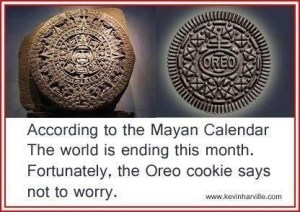
end of the worldI’m kinda hoping this Mayan calendar thing is right as I haven’t paid my cable bill yet this month.  And I’d endure almost anything to make sure the Cowboys miss the playoffs.   On the other hand, I hate to think of all those unused frequent flyer miles I’d lose.  Either way, I’m holding off writing my next post until Saturday–just in case.
cookie

post

Cosmic Quote #12

“Any sufficiently advanced technology is indistinguishable from magic.”–Arthur C. Clarke

No, not that Magic!

No, not that Magic!

To say that Arthur C. Clarke was a visionary is to put it lightly.  In 1947 he published an article advocating a global satellite communication network.  That was ten years before Sputnik, when many serious scientists were still calling space travel impossible.  Yet even he didn’t always get it right.  In the 1960’s he foresaw humanity’s 2001 future in outer space, but little progress was made in the following decades.  It turned out the human future in the new millennium was in cyber space.  My future, then and now, continues to be spaced out.  I’ll see you in my dreams…

post

Equations of Everyday Life#3: Media Attention Span (Part One: The Media–illogical Constant)

“It was my biggest blunder.”–Albert Einstein on his cosmological constant concept.

You have to love ‘ol Albert.  It’s not that he admitted he was wrong.  It’s that he turned out to be wrong about being wrong. In other words, the cosmological constant turned out not to be such a big blunder after all.  He thought that there must be a force in the universe that counteracts gravity and prevents a static universe from contracting on itself.  In 1917 he dubbed it the cosmological constant.  Then came Hubble’s discovery in the 1920’s that the universe is expanding, which was closely followed by the big bang theory (the actual theory, not the TV show), and out the window went Einstein’s constant.   But then, in 1998, it was discovered that the expansion of the universe is accelerating and–bingo!–the cosmological constant, now referred to as dark energy, was reborn.

So what the hell does this have to do with the current equation?  It’s also a constant, and it might turn out that it is as slippery and elusive as dark energy.  The difference though, is that this one describes contraction, not expansion; more specifically, the contraction of media attention over time as pertains to inane celebrity behavior.  I call it:

The Media-illogical Constant

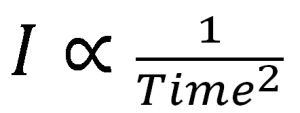
If you’ve had any physics education, you’ve certainly heard of the inverse square law.  It applies to any number of physical properties, gravity, light, radio waves, sound or the attention level of undergraduates to a lecture in a large hall.  Simply stated, as one travels away from the source, the intensity of the force or signal decreases by the inverse of the distance squared.  A similar equation can describe the rate at which our tabloid-minded western media lose interest in stupid celebrity hijinks.  The equation is the same as the inverse square law with one modification:  just substitute time for distance.    Quite simply, it looks like this: 
inverse squareIn plain English:  the intensity of the media attention is proportionate to the inverse of the time since the story’s emergence to national (or international) attention, squared.  So when Lindsay Lohan gets arrested–yet again–the media attention four days after the story will be 1/16th of what it was when the story broke.  [Are you are wondering why this equation just doesn’t use an equal sign instead of a proportional to sign? It beats me.  But one immutable rule of these posts is to always use the coolest looking symbol possible.]
.
There are, of course, caveats–aren’t there always?  This theoretical pronouncement exactly works, if, and only if, there is no significant obstruction or interference from other media events, whether or not they involve inane celebrities.  This is the same as applies to physical properties measured with the inverse square law.    Place a brick wall between the light source and your measuring device and all bets are off.  Likewise,  a bigger story may come along and completely drown out whatever Lady Gaga has been up to lately.   I have a name for this phenomenon and resulting calculations–pretty cheeky of me since I haven’t even invented it yet.  I call it The Big Bust Theory.   Depending on the stories involved, this may or may not be a double entendre.  Either way, part two of this post will deal with that equation.  It’s coming soon to a blogoshere near you.
post

Cosmic Quote #11

“If people think nature is their friend, then they don’t need an enemy.”–Kurt Vonnegut

Image credit: CartoonStock.com. Used by permission

Clearly, anyone who took the brunt of Sandy can identify with that quote.  Hurricanes, tornadoes, earthquakes, droughts, tsunamis.  Nature packs plenty of punches.  Wait, you mean it’s organic foods and natural remedies you embrace? OK, I’ll counter with hemlock, radon, arsenic, curare. Good grief, there are easily as many natural ways on this earth to kill us as their are to enhance us.  And most of the rest of the universe would kill us in an instant.  Sure, there is plenty of beauty and benefit in nature.  But anyone who hasn’t grasped the implications of the second law of thermodynamics hasn’t a clue what nature really is–or how amazing it can be.

post

Quantum Weirdness 105, Review: How to teach Quantum Physics to Your Dog

        “I have a very good nose. I can sniff into extra dimensions. They’re full of evil squirrels. With goatees.”–

Chad Orzel’s dog, in How to Teach Quantum Physics to Your Dog.

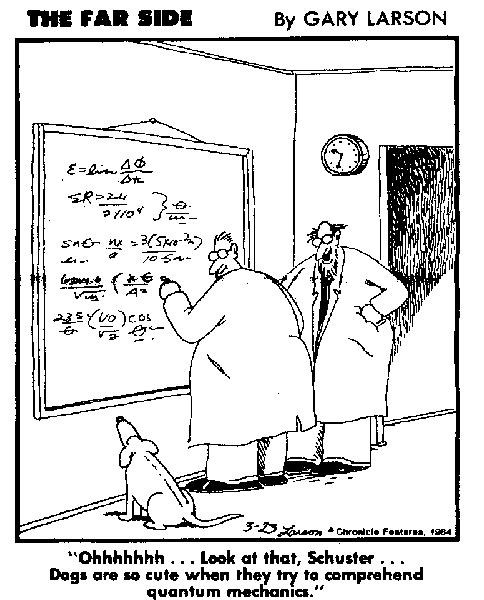
Chad Orzel is my kind of guy.  If it wasn’t for the fact that How to Teach Quantum Physics to Your Dog was copyrighted in 2010, I would have sworn he had read my Law of Canine Chaos before writing the following.

Sound waves are pressure in the air.  When a dog barks, she forces air out through her mouth and sets up a vibrations that travel through the air in all directions.  When it reaches another dog, that sound wave cause vibrations in the second dog’s eardrums, which are turned into signals in the brain that are processed as sound, causing the second dog to bark,  producing more waves, until nearby humans get annoyed.  [emphasis mine]

Amen, brother.

But the point is, he explains and summarizes beautifully–and expands upon lucidly–all the points in my first four Quantum Weirdness posts.  He does so in a manner clear enough that, if you can’t understand it, at least your dog will.  Maybe the pooch can then explain it to you. Either way,  I recommend it highly.  Unfortunately, though,it seems to be out of print in the US.   It is available, mostly from the UK, from various resellers on ebay and barnesandnoble.com.  Orzel has also written How to Teach Relativity to Your Dog and How to Teach Physics to Your Dog.  Before you know it, those clever mutts will be running the LHC at CERN.  I doubt they will be looking for the Higgs Boson, though.

Copyright 1984, Chronicle Features

post

Millennium Conjecture #3: The Future (Part Two)

I Conjecture:  Every Possible Future Exists

Part Two: Quantum Mechanics and The Future

“The best way to predict the future is to invent it.”–Alan Kay

Note: In case you had not surmised it, the most literal title for this conjecture would be “Every Physically Possible Future of Our Universe Exists.”   There is probably not a future in our universe where the laws of physics will change to allow Harry Potter to cast a patronus spell on demontors.

Inventing the quantum future at NASA

Alan Kay’s proposition suggests a philosophical viewpoint that emerges from this conjecture.  But for a better quote to describing its why and wherefore, I harken back to the E.B. White words from Conjecture #2Everything that is not forbidden is mandatory.  It all boils down to Quantum Mechanics.   Many physicists have latched on to this notion;  given enough time, every physically possible combination of matter and energy is bound to occur.  It’s all just a matter of probability.  That said, there are clearly at least two distinct ways of looking at it, depending on which interpretation of quantum mechanics you ascribe to:  Copenhagen or Many Worlds.  Although there are other interpretations, these two have garnered the lions share of advocates in the scientific community, and the notion that every possible future exists can emerge from either one of them.  (See Quantum Weirdness 102 and 103 in this blog for an explanation of both ideas.)

The difference between the two as pertains to the future can easily be stated as virtual vs. actual.  The Many Worlds interpretation asserts that every physical possibility will become an actual reality in an infinitely expanding sea of parallel universes.  Every possible future is, or at least becomes, physically real.  On the other hand, Copenhagen implies that there is no absolute physical reality until the quantum wave function breaks down, that there is only probability on the sub-atomic level until we observe it. From this we can infer that every possible future exists only as a statistical  probability, and only the one we ultimately experience will actually exist.

So what’s the difference?  There isn’t any.  It makes no difference, from the practical experience of entities conscious in a single one of them, whether the futures are real or virtual; we can’t tell the difference.  Every one of those physical realities is still a real possibility.  The good news?   There most certainly is a future out there where you win the lottery!  The bad news?  The only sure way to “invent” that future is to buy every possible number combination.  I don’t recommend quitting your day job.  😦

Up next: The Conjecture of Composite Consciousness.  (Warning: the next couple of conjectures will be quite a bit more radical and original than the those already stated herein.  Actually, I’m warning myself.  Anybody know where I can get some flame retardant garb?)

post

Cosmic Quote #10

“Do you realize that if it wasn’t for Edison we’d all be watching TV by candlelight?”–Al Boliska

Image Credit: Doug Savage. Click for link.

If Sandy wasn’t enough, no sooner did our power come back then, in succession over the next few days, one  of my two office desktop PCs died, followed by the monitor for the other one, followed by my cable modem.  Then the icing on the cake was my business phone land line going dead.  If it wasn’t for broken technology, I’d have no technology at all.   At the rate this is going, I will soon be sending emails via pony express.

post

The BLAHS #2: Millard Fillmore’s Bathtub

“To refuse awards is a way of accepting them with more noise than normal.”–Mark Twain (also attributed to Peter Ustinov)

The absolutely awesome BLAHS logo which adorns the tee shirts and refrigerator magnets awarded to the winners.

Thread update:   Since last we visited the BLAHS (BLog Awards Handed out by Sackler) I have been”nominated” for three more blog awards myself.   I used quotes around the term nominated because there are conditions behind accepting these particular awards. One must, depending on the award in question, “nominate” between five and ten other blogs for the award.  (You’ve probably seen many a blog boasting one of these awards:  Versatile Blogger Award,  One Lovely Blog Award, etc.). See, the thing is, these amount to the blogging equivalent of a chain letter.  If money were involved, it would be a Ponzi scheme;  the math doesn’t work too well.  If everybody nominated were to participate to the fullest extent possible, then within between ten and fifteen iterations there would be more awards handed out than there are people alive on this planet today.  How else would I be cited for three of them in less than six months of blogging? (Yeah, my ego is big, but not that big.)   Don’t get me wrong, I appreciate these other bloggers thinking of me, and will acknowledge them at the bottom of this post.   But I don’t do chain letters, multi-level marketing or Ponzi schemes, so I chose to create more noise by not accepting them.  (And at least my BLAHS are handed out one at a time, even if otherwise worthless).

Without further ado, the winner of BLAHS #2 is…

Ed Darrell of MILLARD FILLMORE’S BATHTUB.

What could be more appropriate?  The first BLAHS went to The Blog of Funny Names.  So why shouldn’t the next one be awarded to the funniest named blog I know, after the funniest named president that most of us have ever (or never) heard of?  To be accurate, though, it’s not named after Millard Fillmore himself, but after one of the oddest hoaxes in American journalism history.  It was promulgated by H.L.Mencken,  who on December 28, 1917 published a story in The Evening Mail, stating that the date was the anniversary of the installation of the first bathtub in the White House by Fillmore in 1850.  It was complete bunkum;  yet to this day it has repeatedly been cited as fact–as this link recounts in detail.  This account clearly proves that fact checking in journalism and history is not dead–it never really existed in the first place.  Mencken intended the story as a joke, and was stunned that it was taken seriously despite several obvious fabrications. Fillmore’s hometown of Morovia, NY certainly has a sense of humor about the whole thing.  They stage an annual Millard Fillmore Day which for years featured a bathtub race as one of the main events.

The great Fillmore himself. Sadly, no images of his bathtub survive.

“Secondhand, commonplace, mediocre, undistinguished: these are the words that spring naturally to mind as one surveys Fillmore’s brief rise from obscurity and quick descent into oblivion,”–Paul Boller in “Presidential Anecdotes.”

Back to the award, though. Millard Fillmore’s Bathtub, the blog, touts itself as “striving for accuracy in history, economics, geography, education, and a little science.”  (Why only a little science, I have no idea).  But who cares?  Yes, the content is lively and interesting, but the name and premise it is based on is almost worthy of the award in and of itself.  Congrats, Ed, and keep up the good work.

The Prize

I promised to strive to find a completely useless prize for this award.  I almost did it.  I have fashioned a tee shirt and matching refrigerator magnet out of the logo which appears above.  Not useless?  Well, I figure nobody would actually want to show off this award, so the logo should do the trick.  Yes, I know, the tee shirt could still be used as a dishrag.  But short of a monogrammed piece of lint, this was the best I could think of;  I’m also betting somebody out there will think of a use for the lint.

Three Blogs of Note

These are the blogs that nominated me for the awards mentioned in the preface at the top of this article.  While I have chosen not to participate in these awards, I do appreciate their thinking of me–and I do read and recommend their respective blogs.

Sciencelens               Essa On Everything          The Art Frog

(Postscript:  It occurs to me that H.L. Mencken was also the author of many great quotes, one or more of which is bound to turn up in one of these posts.)

post

Time Out: Google This! (or The Color of Stupidity, Part 2)

“The Internet is a good way to get on the net.”–Bob Dole

I preferred the candidate that did not need such enhancement. Credit: Edward Cropper. Click image for link.

The above quote has to be the best thing Yogi Berra never said.  But I digress even before I get started.

With increased traffic comes increased search engine hits.  With increased search engine hits comes more great, completely irrelevant material.  I won’t bore you with repeating the whole story, if you missed the first installment of this feature, you can read it here.   So without further ado, let’s see what some of the less-than-sentient beings out there have been up to–here are more search engine queries that somehow found this blog, each followed, as usual, by my astute analysis.  (Image credit: Edward Cropper)

Vidoe— noe kiddinck?

Stupid names for your entertainment–I already covered that in detail here,  but how about….hmmm….Adam Sandler movies?

Equaions (sic!) in everyday life–the search engines speak Klingon now.

Examples of square roots in real life–my response is too terrifying for a family blog.  Click here if you must know the answer. (Actually, it’s really worth the click 😀 )

Satir Kipec–Nagrado žirija lahko podeli  (I hope that’s not obscene–I copied it from the start of the first link this search term returned.)

Figure X. Schipperke [Pronunciation: Skip-it; Origin, Dutch: Little S&$^%#–er, I mean Little Captain] Noun: 1. A Furry black dog of Belgian origin 2. Trouble waiting to happen

I’m part Schipperke–I bet you’re a little bit pregnant, too.

Examples of squares in everyday life–Bob Dole and Howard Walowitz.

Did Schrödinger’s cat blow up?–No, but it did come away with a hickey.

Malenium (sic!) conjectures–guys don’t conjecture; we just take wild guesses.

We also write wild blog posts.  Stay tuned.  There are evidently bound to be more of these.

post

Cosmic Quote #9

“The two most common elements in the universe are hydrogen and stupidity.”–Harlan Ellison

Credit: Doug Savage. Click image for link.

Wow.  He got that right.  The latter seems particularly abundant these days;  on a Monday morning during election season I have no patience for it.  What is dumber, the idiot political wonks who put out all the attack ads, or the few remaining idiot voters who actually pay attention to them?   I’ll vote for the genius who promises to start the work week on Tuesday!  (I’m not in education or government or banking–I have to work on Columbus Day.)  Check out my Google search terms post for more on stupidity.  🙂