post

Time Out: Google This! Search Term Haiku

“If it isn’t on Google, it doesn’t exist.”–Jimmy Wales

funny_google_search_result_-722978

The last thing you want to do is throw down a challenge to this blogger.  Ever.  But that’s exactly what Elke Stangl did when she created search term poetry on her blog, Theory and Practice of Trying to Combine Just Anything.  First of all, Elke has a resume that reads like a character from The Big Bang Theory. She describes her self as a physicist turned IT security consultant turned renewable energy engineer–all this plus a stint with Microsoft.   But that aside, her big mistake was suggesting that I try my hand at search term poetry.  I will not be outdone.   Be careful what you wish for Elke, cause here comes Search Term Haiku.  The rules are simple, but the creation is anything but easy.

  1. Every word must come from search terms actually used to find this blog, per my WordPress stats page
  2. The poems must follow the accepted Anglicized format of the traditional Japanese art form: three lines of 5, 7 and 5 syllables respectively.
  3. Each line must constitute an actual individual search term phrase, verbatim.  The only change allowed is punctuation.

You asked for it, Elke.  So here they are.  (Note:  I may have to bestow a BLAHS on Elke for inspiring this idea.  But not the next one, as that has already been determined and will be posted soon.)


HAHA

Siri lacks humor.

Did Schroedinger’s Cat Blow up

Albert Einstein’s hair?


Non Sequitor

Stupid search engine:

16 Times 4 equals what?

Lawn bowling cartoons


What’s in a name?


Mahatma Gandhi

Luna Rosa Pirana

Lindsay Lohan meme


Canine Crazy


Are Dogs Chaotic?

If you roll the dice enough times

I’m part schipperke.


Quixotically Quantum


Haldane conjecture:

Many worlds are around us

so why don’t you leave.

 
post

Cosmic Quote #13

“The main reason Santa is jolly is he knows where all the bad girls live.”–George Carlin

Hmmm.I Wonder what he's looking for...(www.savagechickens.com, click for link)

Hmmm.I Wonder what he’s looking for…(www.savagechickens.com, click for link)

I knew there was a reason I was jealous of the guy.  I also now know what he is doing the other 364 days while the elves are making all the toys.  At any rate, this non-theistic, almost-atheist existentialist wishes you a Merry Christmas, Season’s Greetings, happy pagan winter solstice, or whatever it is you celebrate.

post

Equations of Everyday Life#3–Media Attention Span (Part Two: The Big Bust Theory)

According to my calculations [the universe] didn’t start with a “Big Bang” at all—it was more of “Phhbwt.”–Dilbert (Scott Adams)

This kind of bust? Well...maybe....

This kind of bust? Well…maybe….

In the stirring first episode of this equation, we saw how the attention paid by the media to inane celebrity stories erodes naturally over time through a process I dubbed The Media-illogical Constant.   But like many scientific theories, it is more complicated than it appears on paper.     It seems that this equation works well in a comparative media vacuum, free from the interference of new, bigger and even more outrageous celebrity stories. And though a story may also, in the absence of said later distraction,  sustain itself through the generation of new angles, it can still disappear in an instant.  When a  bigger celebrity story comes along and wipes clean the public attention-span slate, the previous prime meme is sucked into a media black hole.  It succumbs to The Big Bust Theory. I may not be able to quantify this occurrence; but I can certainly give a primordial example.

It  was 1994 and  two key dates in that year represent the ground zero points for the archetypal media big bust.

The Tonya Harding Fiasco

On January 6, 1994 a man named Shane Stant swung a lead pipe at figure skater Nancy Kerrigan’s knee, causing sufficient injury to Kerrigan that she was forced to withdraw from the US championships.  In and of itself, this would have kept the cable news and sports channels going for weeks on end, but it was only the beginning.   Within a few days, the dastardly deed was traced back to associates of one Tonya Harding, who just happened to be Kerrigan’s main rival at the competition.  The frenzy was on. All throughout the spring and summer the story took more twists and turns than a Dickens novel.  (You can read the entire timeline here).  The name Tonya Harding was on every front page and every evening news lead.  On and on into the the spring and early summer, it reached the point that many–yours truly included–wished she and her story would just go away.

Be careful what you wish for.

The Big Bust: June 17 1994

oj-simpson-mshot-700217Just when you thought there would be no end to the Harding nonsense–no “return to normalcy” to quote another famous American named Harding–the story imploded.  On  June 17, 1994 cable news channels broadcast, live and in living color,  an event so momentous that it interrupted the broadcast of the NBA finals.  It was the pursuit by the LAPD of O.J. Simpson. (Case timeline here.)

Poof. The Tonya Harding story was gone from the front pages and evening news leads, never to return to such prominence again.

As for trying to create and algorithm that describes this phenomenon, it has so far escaped me.  In the same manner that the laws of physics seem to break down in the singularity at the center of a black hole, all measures of media (and public) vacuity in the face of these kinds of events defy calculation.  The equations yield infinities.  If you have any ideas, feel free to post them here.  But have no fear, this scenario has given me yet another idea.  It’s clear that two of the biggest media attractors going are inane celebrity antics and sensational crimes.  When the two combine, as they did in both the OJ Simpson and Tonya Harding cases, the effect just screams for its own equation…and this might ultimately yield the mathematical solution to The Big Bust Theory.

post

Time Out: End of the World Post(poned)

“In the beginning, the universe was created.  This made a lot of people very angry and was widely regarded as a bad move.”–Douglas Adams

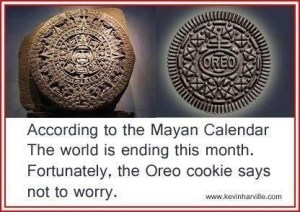
end of the worldI’m kinda hoping this Mayan calendar thing is right as I haven’t paid my cable bill yet this month.  And I’d endure almost anything to make sure the Cowboys miss the playoffs.   On the other hand, I hate to think of all those unused frequent flyer miles I’d lose.  Either way, I’m holding off writing my next post until Saturday–just in case.

cookie

post

Equations of Everyday Life#3: Media Attention Span (Part One: The Media–illogical Constant)

“It was my biggest blunder.”–Albert Einstein on his cosmological constant concept.

You have to love ‘ol Albert.  It’s not that he admitted he was wrong.  It’s that he turned out to be wrong about being wrong. In other words, the cosmological constant turned out not to be such a big blunder after all.  He thought that there must be a force in the universe that counteracts gravity and prevents a static universe from contracting on itself.  In 1917 he dubbed it the cosmological constant.  Then came Hubble’s discovery in the 1920’s that the universe is expanding, which was closely followed by the big bang theory (the actual theory, not the TV show), and out the window went Einstein’s constant.   But then, in 1998, it was discovered that the expansion of the universe is accelerating and–bingo!–the cosmological constant, now referred to as dark energy, was reborn.

So what the hell does this have to do with the current equation?  It’s also a constant, and it might turn out that it is as slippery and elusive as dark energy.  The difference though, is that this one describes contraction, not expansion; more specifically, the contraction of media attention over time as pertains to inane celebrity behavior.  I call it:

The Media-illogical Constant

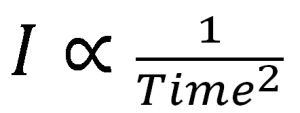
If you’ve had any physics education, you’ve certainly heard of the inverse square law.  It applies to any number of physical properties, gravity, light, radio waves, sound or the attention level of undergraduates to a lecture in a large hall.  Simply stated, as one travels away from the source, the intensity of the force or signal decreases by the inverse of the distance squared.  A similar equation can describe the rate at which our tabloid-minded western media lose interest in stupid celebrity hijinks.  The equation is the same as the inverse square law with one modification:  just substitute time for distance.    Quite simply, it looks like this: 
inverse squareIn plain English:  the intensity of the media attention is proportionate to the inverse of the time since the story’s emergence to national (or international) attention, squared.  So when Lindsay Lohan gets arrested–yet again–the media attention four days after the story will be 1/16th of what it was when the story broke.  [Are you are wondering why this equation just doesn’t use an equal sign instead of a proportional to sign? It beats me.  But one immutable rule of these posts is to always use the coolest looking symbol possible.]
.
There are, of course, caveats–aren’t there always?  This theoretical pronouncement exactly works, if, and only if, there is no significant obstruction or interference from other media events, whether or not they involve inane celebrities.  This is the same as applies to physical properties measured with the inverse square law.    Place a brick wall between the light source and your measuring device and all bets are off.  Likewise,  a bigger story may come along and completely drown out whatever Lady Gaga has been up to lately.   I have a name for this phenomenon and resulting calculations–pretty cheeky of me since I haven’t even invented it yet.  I call it The Big Bust Theory.   Depending on the stories involved, this may or may not be a double entendre.  Either way, part two of this post will deal with that equation.  It’s coming soon to a blogoshere near you.
post

Cosmic Quote #10

“Do you realize that if it wasn’t for Edison we’d all be watching TV by candlelight?”–Al Boliska

Image Credit: Doug Savage. Click for link.

If Sandy wasn’t enough, no sooner did our power come back then, in succession over the next few days, one  of my two office desktop PCs died, followed by the monitor for the other one, followed by my cable modem.  Then the icing on the cake was my business phone land line going dead.  If it wasn’t for broken technology, I’d have no technology at all.   At the rate this is going, I will soon be sending emails via pony express.

post

Hurricane Rerun: The Sackler Laws (Part 2 1/2)

Here is part two of the rerun which began on Monday.  If the northeast USA has been washed away by the time you read this, consider it my last will and testament.  If not, brace yourself for something new by the weekend.

The Laws of Kid and Canine Chaos

Having kids is like having a bowling alley installed in your brain.”–Alan Bleasdale

Part B: The Equation of Kid Chaos.  As the number of kids in any household or otherwise confined environment increases, the chaos generated by said kids increases logarithmically.

As we saw in Part A of this law, The Equation of Canine Chaos, dog generated insanity increases exponentially as dog population increases.  With kids it is infinitely more complex; so we see:

Heaven help us! (even if we are not pious)

When n=1 then Ck=1, but when n>1 then Ck=10n-1

So…n is the number of kids present in a given environment, and Ck is the potential kid-generated chaos in that environment.   In plain English?  The potential chaos increases by an order of magnitude with each kid added!  In other words—for the mathematically challenged among you—two kids may be 10 times as chaotic as one; three may be 100 times as chaotic; four, 1000 times, and so on.

But the increase in analytical complexity here is far greater than the math.  For dogs, the equation is for actual chaos and is a good average.  For kids, it is only for potential chaos, and is somewhere between an approximation and a wild guess.  For one thing, the interactions between children are so complex that they quickly become incalculable.  A good metaphor for this is Newton’s laws of gravity when applied to orbital mechanics of celestial objects: the interaction between two of them is precisely calculable, but as soon as you add even one more the math becomes intractable.

This does not even bring into the equation the question of other variables, such as age, upbringing, setting and proximity to bedtime.  Setting is particularly important.  For example, put 20 nine-year-olds in a catechism class taught by an angry nun wielding a ruler, and the chaos will appear so infinitesimal even the CERN supercollider would be hard pressed to detect it.  Now put the same twenty kids in an unsupervised free swim in a public pool, and you’ll pin the needle on the Richter scale.

But wait, it gets worse!  Dog chaos is pretty obviously measured by noise and activity; but with kids that doesn’t completely tell the tale.   Even when they are quiet there is no telling what’s going on in their little crania.  Take, for example, those twenty tykes in the catechism class.  They may appear behaved now, but what they are plotting to do to that nun when class gets out makes Lord of the Flies look like a sitcom.

This brings us to the most perplexing problem of all: putting multiple kids and dogs together and attempting to calculate what will happen.  It is not unlike trying to unify relativity and quantum mechanics into a single theory of quantum gravity.   In discussing this with my cousin Marion, I asserted that she could not imagine what the equation would look like.  Her sly reply was that she could not even imagine what the room would look like!  Not being one to back off from a challenge, I found this image which fairly represents what both the resulting math and the domicile will look like.

The Equation of Combined Kid AND Canine Chaos


With that,  have a great holiday week and brace yourself for more.

post

Hurricane Rerun: The Sackler Laws (Part 2)

By the time you read this, hurricane Sandy will be pounding the northeast US.  I’m not one to let that stop me; this post has been pre-scheduled.  For those of you who have come late to this blog–or who need a reminder as to what inspired Equations of Everyday Life–here is the first part of two reruns.  If I don’t post something new within a week, send out a search party.

The Laws of Kid and Canine Chaos

“Chaos is inherent in all compounded things.” –Buddha

Part A, the equation of canine chaos: As the number of dogs in any household, or otherwise confined environment increases, the chaos generated by said dogs increases exponentially.

The math on this one is easy and so is the logic. Let’s start with an easy equation:

Cd=D2

Simply stated, where Cd equals canine chaos and D equals the number of dogs present, then canine chaos equals the number dogs present squared. So two dogs equals four times the chaos, three dogs equals nine times the chaos, four dogs 16 times, and so on.

As for the logic, that’s also easy. Assuming that dogs are a pack animal, then each chaotic activity started by one, will be joined in by the others. This includes, but is not limited to, barking, fighting, knocking over the trash, attacking the mailman, biting Aunt Millie, pooping in the hallway, stealing your lunch and whatever other crazy things canines do. So, if there are two dogs, it will happen twice as often and be twice as chaotic each time. If there are three dogs, it will happen three times as often and be three times as chaotic. You get the idea.

Disclaimer: this equation is an average. Obviously, geriatric dogs will create less chaos and puppies are off the chart crazy. The breed of dog is a factor as well. (See figure X, schipperkes, and figure Y—as in “why?”—labs)

Figure X. Schipperke [Pronunciation: skip-it; origin: Dutch, meaning little s&$^%#–er, I mean, “little captain”] Noun: 1. a furry black dog of Belgian origin 2. trouble waiting to happen

Figure Y. As in, “why do people keep these things?” (attribution of photo unknown)

Take for example, our own pack of three (if you can believe that) schipperkes. They have the uncanny knack of lulling us into complete complacency. Then a chipmunk runs across the lawn and our former state of quietude is instantly transformed into the canine equivalent of One Flew Over the Cuckoos Nest. I’m sure insanity is zoonotic. You get it from your pets.

We also need to consider that there are limits to the human capability to distinguish between degrees of canine chaos. At some point, the saturation point is reached, and the perceived chaos is effectively infinite. Beyond this, addition of more dogs to the environment cannot inflict any measurably higher degree of pain. These limits may vary with the individual. I, for instance, have lived with multiple dogs for years and therefor have a higher threshold of tolerance than the average person. On the other hand, my wife is a veterinarian and is effectively immune. Our dogs could stage World War III on top of her head in the middle of the night, and she would sleep through it. [NOTE: Part B, the Law of Kid Chaos, coming soon in a future post.]

Text in the post ©2012 Mark Sackler

post

The BLAHS #2: Millard Fillmore’s Bathtub

“To refuse awards is a way of accepting them with more noise than normal.”–Mark Twain (also attributed to Peter Ustinov)

The absolutely awesome BLAHS logo which adorns the tee shirts and refrigerator magnets awarded to the winners.

Thread update:   Since last we visited the BLAHS (BLog Awards Handed out by Sackler) I have been”nominated” for three more blog awards myself.   I used quotes around the term nominated because there are conditions behind accepting these particular awards. One must, depending on the award in question, “nominate” between five and ten other blogs for the award.  (You’ve probably seen many a blog boasting one of these awards:  Versatile Blogger Award,  One Lovely Blog Award, etc.). See, the thing is, these amount to the blogging equivalent of a chain letter.  If money were involved, it would be a Ponzi scheme;  the math doesn’t work too well.  If everybody nominated were to participate to the fullest extent possible, then within between ten and fifteen iterations there would be more awards handed out than there are people alive on this planet today.  How else would I be cited for three of them in less than six months of blogging? (Yeah, my ego is big, but not that big.)   Don’t get me wrong, I appreciate these other bloggers thinking of me, and will acknowledge them at the bottom of this post.   But I don’t do chain letters, multi-level marketing or Ponzi schemes, so I chose to create more noise by not accepting them.  (And at least my BLAHS are handed out one at a time, even if otherwise worthless).

Without further ado, the winner of BLAHS #2 is…

Ed Darrell of MILLARD FILLMORE’S BATHTUB.

What could be more appropriate?  The first BLAHS went to The Blog of Funny Names.  So why shouldn’t the next one be awarded to the funniest named blog I know, after the funniest named president that most of us have ever (or never) heard of?  To be accurate, though, it’s not named after Millard Fillmore himself, but after one of the oddest hoaxes in American journalism history.  It was promulgated by H.L.Mencken,  who on December 28, 1917 published a story in The Evening Mail, stating that the date was the anniversary of the installation of the first bathtub in the White House by Fillmore in 1850.  It was complete bunkum;  yet to this day it has repeatedly been cited as fact–as this link recounts in detail.  This account clearly proves that fact checking in journalism and history is not dead–it never really existed in the first place.  Mencken intended the story as a joke, and was stunned that it was taken seriously despite several obvious fabrications. Fillmore’s hometown of Morovia, NY certainly has a sense of humor about the whole thing.  They stage an annual Millard Fillmore Day which for years featured a bathtub race as one of the main events.

The great Fillmore himself. Sadly, no images of his bathtub survive.

“Secondhand, commonplace, mediocre, undistinguished: these are the words that spring naturally to mind as one surveys Fillmore’s brief rise from obscurity and quick descent into oblivion,”–Paul Boller in “Presidential Anecdotes.”

Back to the award, though. Millard Fillmore’s Bathtub, the blog, touts itself as “striving for accuracy in history, economics, geography, education, and a little science.”  (Why only a little science, I have no idea).  But who cares?  Yes, the content is lively and interesting, but the name and premise it is based on is almost worthy of the award in and of itself.  Congrats, Ed, and keep up the good work.

The Prize

I promised to strive to find a completely useless prize for this award.  I almost did it.  I have fashioned a tee shirt and matching refrigerator magnet out of the logo which appears above.  Not useless?  Well, I figure nobody would actually want to show off this award, so the logo should do the trick.  Yes, I know, the tee shirt could still be used as a dishrag.  But short of a monogrammed piece of lint, this was the best I could think of;  I’m also betting somebody out there will think of a use for the lint.

Three Blogs of Note

These are the blogs that nominated me for the awards mentioned in the preface at the top of this article.  While I have chosen not to participate in these awards, I do appreciate their thinking of me–and I do read and recommend their respective blogs.

Sciencelens               Essa On Everything          The Art Frog

(Postscript:  It occurs to me that H.L. Mencken was also the author of many great quotes, one or more of which is bound to turn up in one of these posts.)

post

Equations of Everyday Life #2: Inane Celebrity Memes

“You’re not famous until my mother has heard of you”–Jay Leno 

(Jay Leno graduated from Emerson College the same year I did.  Aren’t you unimpressed?)

Lindsay Lohan…Paris Hilton…Charlie Sheen…you just gotta follow these people to be “with it” in this day and age.  What I can’t figure out is exactly what “it” is. The nonsense involving these silly (do I dare say ridiculous?) excuses for humanity, and the speed with which their inane meme virality propagates throughout the internet and general mediasphere is stultifying.

 How do we quantify this vacuous tripe?  Quite obviously with:

The Index of Inane Celebrity Meme Virality

Get out your calculators folks, though the math on this one may require something more like a Cray supercomputer.   This process requires not one step, but three.

  1. Rate the inanity
  2. Compute the Virality Index
  3. Classify the virality using the Virality Classification Scale

Rating Inanity

This part is for those of you who—like many politicians—prefer fuzzy math.  In order to compute the virality of an inane celebrity meme, you first need to give it an inanity rating.  This, however, does not compute.  You need to estimate it by a process that could be seen as similar to the way we old folks were taught to compute square roots in days before electronic calculators.  You sort of have to zero in on it—surround it, using  a combination of whatever logic or intuition works for you.

Using a scale of 0 to 1.0, we rate the inanity based on how unusual, how cable newsworthy and, of course, how inane it appears to be.  Using the Lindsay Lohan example, let’s rate some real and imagined events.

Lindsay Lohan gets up in the morning and brushes her teeth (or not).  Probable rating=0  (probable rating because, again, there is some subjectivity here).

Lindsay Lohan gets busted for another probation violation.  Approximate rating=0.5 (This is fairly commonplace but due to media culpability still maintains some newsworthiness.  Also, the specific story behind the arrest may result in some adjustment up or down; the next item demonstrates this.)

Charlie Sheen stubs his toe on the curb of 34th Street in NYC, stumbles into oncoming traffic causing Lindsay Lohan to swerve her speeding Porsche through a display window at Macy’s, decapitating several mannequins, skidding across the retail floor and then crashing through a sidewall into a back room where she runs over Paris Hilton who was in the act of giving her boyfriend a you-know-what.  Absolute rating of 1.0.  This theory does not permit a rating higher than 1.0, but we’ll give this one a 1.0 with a star, meaning it also generates spontaneous orgasms in Jon Stewart, Stephen Colbert and every Fox News and CNN anchor past, present and future.  (Note that while coverage on Comedy Central will actually lampoon the coverage by the other networks, this will add even greater fuel to the viral fire than serious reporting).

Computing the Virality Index

Here comes the fun.

ξ = Φ(F+T)(µ-110)

Symbol key

ξ =Virality Index I chose that squiggly symbol because I think it looks like Kate Middleton mooning the paparazzi.

Φ =Inanity rating Aren’t those Greek thingies cool? This one is iota, as in “I don’t give one iota of a hoot about these nitwits”.

F= number of “friends” or “likes” on celebrity’s Facebook page

T= number of Twitter followers of the celebrity There is a reason they call it TWITter.

µ =the median IQ of the set whose members are F+T. For the uninitiated µ is the scientific symbol for micro.  How appropriate. (Can’t you just imagine those two sentences being uttered by Dr. Sheldon Cooper?)

To sum it up:

The virality index is the inanity rating multiplied by the combined number of Twitter and Facebook followers multiplied by what I call the vacuity index (median IQ of all followers minus 110).

Classify the Virality

For any chance at virality, the final Index number MUST be negative.  This works perfectly fine for most of the personalities discussed above.  If we are talking about Stephen Hawking, however, there is a better chance of finding virality in the singularity at the center of a black hole.

The classifications of virality are as follows

If ξ ≤  -100,000  minimally contagious

If ξ ≤  -500,000  highly contagious

If ξ ≤  -1 million  immutably viral

If ξ ≤  -10 million globally pandemic

If ξ ≤  -100 million worthy of hours of uninterrupted coverage on CNN and FOX News.

Still to be determined is the threshold at which Geraldo Rivera coverage kicks in.

So if we compute the Charlie Sheen meme virality index for the automobile accident scenario hypothesized above,  we multiply the inanity index of 1 times the combined number of his Twitter and Facebook followers (roughly 10.5 million, don’t worry about being exact, this is fuzzy math) times the vacuity index. We will estimate the latter for Sheehan as (100-110)= -10.  This may be generous but 100, after all, is the definition of median IQ.  This yields a score of -105 million.  If you compute and add to this the scores for Paris Hilton and Lindsay Lohan who were also involved in the scuffle,  the Index plunges much lower.  The New York Post would be sure to issue a special edition.

This leaves one unanswered question, however.  We now know how to compute the manner in which these viral memes are turned on.  But what determines how they are turned off?  As you would expect, I have the answer which I call the medialogical constant.  I will discuss this in the next Equations of Everyday Life post, which may or may not be published within your lifetime.

Images credit: Meme Center   All other material in this post ©2012 Mark Sackler