post

Cosmic Quote(s) #34

“I hate Disneyland.  It prepares our kids for Las Vegas.”–Tom Waits

My first ever trip to Vegas was an inadvertent one, way back in 1978.   Driving from LA to Zion national park on our honeymoon,  Cheryl and I stopped on the Vegas strip for lunch.   Today I am headed directly there–no side trips, nothing inadvertent.  Normally, I would not write about a trip until after I take it.  I’m making an exception for this as, after all,  what happens in Vegas stays in Vegas.    I’ll see you when I get back, assuming I don’t stay there.
post

Cosmic Quote #33

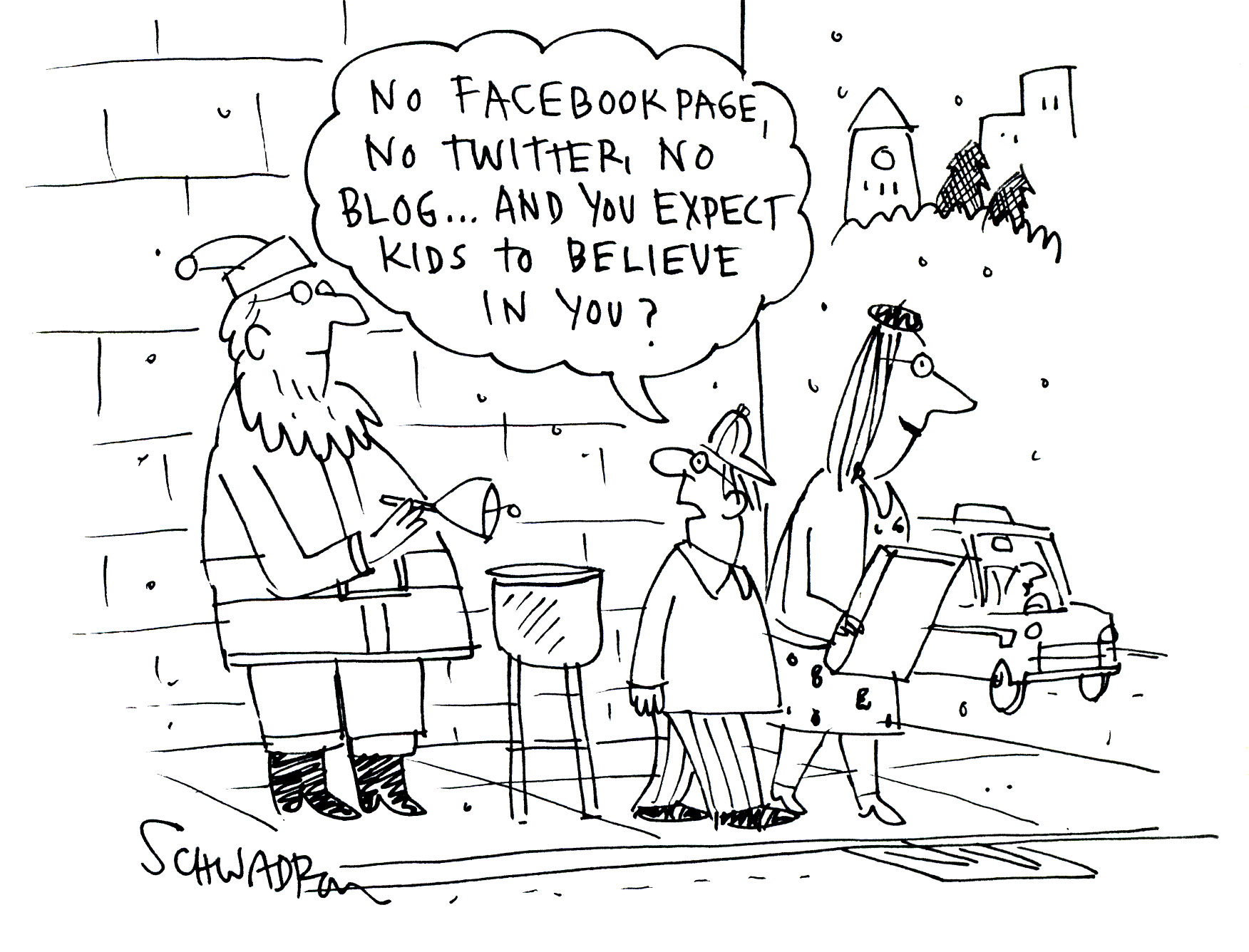
“Santa has the right idea. Visit people once a year.”–Victor Borge

Or don’t visit anyone at all.  Just blog.  Thanks for visiting me here, have an enjoyable holiday season and a prosperous 2014.

post

Conjecture #5–Quantum Solipsism (Part one)

“Cogito Ergo Sum”–René Descartes

“What if god is our dream, and we’re his?”–Christian Bale as Jamie Graham in Empire of the Sun

I conjecture:  In a Many Worlds quantum multiverse, each individual consciousness represents a distinctly different universe.

I'm pretty sure I do exist most of the time--with the possible exception of some Monday mornings.   Exist tee shirts. http://www.zazzle.com/tshirts

I’m pretty sure I do exist most of the time–with the possible exception of some Monday mornings. Exist Tee-shirts. http://www.zazzle.com/exist+tshirts

I once overheard a friend explaining the multitude of religious beliefs to her young daughter in following manner.

She said, “everyone believes something different, and everyone is right!”

Really?  This seems to be the ultimate illogical statement in the illogical realm of religious beliefs.  If everybody believes something different, it seems to me infinitely more likely that everyone is wrong.  I won’t get into the implications for religious beliefs in this conjecture, mainly because I don’t care.  Suffice to say that stretched to an outre extreme,  this conjecture does suggest a manner in which everyone could be right.  It’s always fascinated me how different individuals could be so certain of world views that are so diametrically opposed.  Of course, one can tie that to cultural and cognitive differences resulting in seemingly different worlds.  But then maybe we’re all just be living in our own distinct quantum  universes.

At any rate, if Conjecture #4 was a possible ontological extension of The Copenhagen Interpretation of quantum weirdness,  the current conjecture–#5–clearly emanates from The Many Worlds Theory.

Let’s be clear on one thing.   In my own head, I’m sitting on the fence between Copenhagen and Many Worlds…a kind of quantum superposition, simultaneously believing both.  But let’s get to the heart of the matter before I get too far ahead of myself.

What, exactly, is solipsism?  The brief dictionary description is simple enough: it’s the notion that only the self exists, or can be proven to exist.  Taken to the limit, it can result in a second definition: extreme self-absorption and egoism.

I don’t buy this and am not suggesting it.  While I’m not 100% certain of anything, external or internal, I still believe that you exist and our interactions do influence each other.   We may be in separate parallel universes, but these planes of existence overlap, in much the same way that these universes interfere with each each other on the quantum level.  (It’s worth noting that the conjecture wording says “distinct different” universe and not “distinctly separate.”)  But the fact remains: if The Many Worlds theory holds true the notion of quantum solipsism in some form must be taken seriously.  It’s as if our observations roll the quantum dice and influence which course through the multiverse each individual consciousness takes.  This notion will be the subject of conjecture #6, though at the rate I am going, this may take place a long, long time from now in a galaxy far, far away.  For more on solipsism including more detailed and nuanced description of it, and its various sub-categories, go here.

In the second part of this conjecture, I’ll deal with two very disturbing and controversial extensions of a “strong” quantum solipsism world view.   Quantum suicide and quantum immortality.  You’ll need to hold on to your metaphysical hats for this one.

And if you don’t get any of this, don’t worry.  I’m just impressed that I used “ontological” in a sentence.

Cheers,

Signature

post

Time Out: Possibilianism

“Our reality depends on what our biology is up to.”–David Eagleman

“What a life in science really teaches you is the vastness of our ignorance.”–David Eagleman

Note: Regular followers of this blog will have noted that I avoid discussions of religion and faith issues herein.  There is a reason for this:  I am not interested in discussing them.  Anyway, if you have read many of my posts you will likely have figured out where I stand on this by now.  However, I am making an exception with this post for a specific reason.  Possiblianism is to faith, what these Millennium Conjectures are to physics and metaphysics.  I am speculating on what might be the answers to unknown questions, based on what we do know about physics and cosmology–all the while keeping an open mind and not drawing any absolute conclusions.

In between theism and atheism lies a vast limbo generally referred to as agnosticism.   While the dictionary definition of agnostic is someone who believes the answer to the question of god’s existence and/or the meaning of life is unknowable, the term is often used more broadly.  The agnostic may be undecided.  The agnostic may not care and consider the question irrelevant.  Some point to such individuals and say they are just too wishy-washy to make up their minds.  The common thread among all of these, though, is that the agnostic sees no firm proof either way.  Along comes Possibilianism, which might be seen as a sort of proactive form of agnosticism.

The term Possibilianism was coined and defined by neuro-scientist and author David Eagleman, in discussion of his book, Sum: 40 Tales from the Afterlife.  When asked by an NPR interviewer whether he was a theist or atheist,  Eagleman replied that he considers himself Possiblian.   “I’m open to…ideas that we don’t have any way of testing right now,” he said.  That is a good way of explaining what my Millennium Conjectures are as well.

.

I’ve read Sum, which is a compilation of 40 possible scenarios for what happens when we die;  none of these scenarios are typical religious views of heaven or hell,

or atheist views of eternal nothingness.   Many of the scenarios seem over-the-top bizarre.  Except when you stop to think about it.  None of them are really any more preposterous than what most religions already believe.  But all of them do have rather strong moral or philosophical points to them;  they are all excellent fodder for contemplation.   At any rate, it was a best seller that received rave reviews from the likes of The Wall Street Journal, The Observer and The Los Angeles Times.  

Below is a short You Tube discussion of the concept by Eagleman.  There are much longer ones available if you have the time and inclination.  As for my ever getting to conjecture #5,  I think I’m finally done with the preliminaries, so, yes, it’s a possibility!

post

The Sackler Laws #4: The Law of Political Activism

“Unless someone like you cares a whole awful lot, things are not going to get better.  They’re not.”–Dr. Seuss, The Lorax

“If god had not intended us to eat sugar, he wouldn’t have invented dentists.”–Ralph Nader

Note:  In general, I have avoided the controversies of religion and politics in this blog, though there have been hints at my views on both.  This post tiptoes dangerously towards the precipice of both, though it clearly points no finger at any specific political or religious viewpoint.  I’m bound to get flamed, anyway.

For the fourth and final** installment of the Sackler Laws, I bring you Law #4: The Law of Political Activism.  This is not to be mistaken for Law #1, The Law of Bumper Sticker Activism.  On the other hand, maybe it should be.  Both have to do with taking a good thing too far.  It is simply stated:

First class activists remain forever activists.  Second class activists run for office.

The greatest first class activists of all time, if you look at it carefully, rarely if ever ran for office.  Think Gandhi, Martin Luther King and Susan B. Anthony.  Yes, it’s true that great activists for freedom such as Nelson Mandela and Lech Walesa ultimately became president of the entities their activism wrought; but they were effectively drafted by popular acclaim that arose from the ultimate success of their leadership, they did not attempt to become politicians.

As a primary example of the type of second class activist I present to validate this law, I give you two words.

Ralph Nader.

Here is a guy who pissed off half the country–mostly the corporate world and the Republican right–with decades of pain-in-their-asses activism and left-wing proselytizing.  Then he ran for president on a 3rd party line and pissed off most of the other half of the country.  His siphoning of votes from the left in 2000 almost certainly enabled the election of the candidate most diametrically opposed to his beliefs.  Not satisfied with having made the world, as he saw it, worse, he ran again in 2004 just to thumb his nose at those that might have otherwise been his ally.

That’s about all there is to that.  The only one thankful to him, other than a few diehard loyalists, is me, if only because he gave me the best real world validation I’ve ever had for this aphorism.

But the question then arises.  If we know what a second class activist looks like, what does a third class activist look like. That one’s even easier.

Robertson

Robertson

Sharpton

Sharpton

And you were wondering how I would manage to piss off the religious nuts as well?  If you want inspiration for political activism, the Dr. Seuss quote above is a good place to start.  If you want religious inspiration–you’ve come to the wrong place.

200px-The_Lorax

**Nothing is final except death and…well, except death.  This will only be the final installment of the Sackler laws if I die before thinking up another one.

Signature       @MarkSackler

post

Cosmic Quote #22

“I like physics, but I love cartoons.”–Stephen Hawking

Who knew Hawking had such a sense of humor.  No wonder he hasn’t won a Nobel Prize.  Remind me to introduce him to Stephan Pastis; they might like each other, as the strip below suggests.

This one reads like it was written for Hawking!

This one reads like it was written for Hawking! (click for full image)

(Previously published in my review of Pearls Before Swine. Cartoon ©2012 Stephan Pastis)

.

.

Signature

@MarkSackler

post

Cosmic Quote #19

“Technology is anything that wasn’t around when you were born.”–Alan Kay

Image credit: Andy Singerwww.andysinger.com

Image credit: Andy Singer
http://www.andysinger.com

Gee, the world hasn’t changed all that much in my lifetime, has it?  It’s not like people were still communicating with smoke signals in my infancy.  Let’s see–what didn’t exist when I was born?  Color TV.  Stereophonic sound.  Jet airliners.  Solid state circuitry.  NASA.  Computers smaller than a log cabin.   Ouch!  Mark!  Don’t remind yourself how old you are.  See folks, technology has me talking to myself.  I know… I know… that’s what blogging amounts to in the first place.  Now, back to the salt mines…

post

Cosmic Quote #18

“Quantum mechanics is magic.”–Daniel Greenberger.

Image credit: Matthias Giesen http://matthiasgiesen.wordpress.com/page/8/

Image credit: Matthias Giesen http://matthiasgiesen.wordpress.com

Quantum mechanics.  Niels Bohr said if you’re not shocked by it, you don’t understand it.  Richard Feynman said nobody understands it.  Albert Einstein said god does not play dice. Stephen Hawking said god does play dice and sometimes he hides the results.  I say who the hell cares, as long as they give me fodder for my blog.  Or my wife’s horse.  Or my accountant’s newt.  It all fills  space, thus proving the vacuum is not empty.  Isn’t physics fun?  [Note: vacuum is one of the few words in the English language containing “uu.”   But it’s not as cool as muumuu, duumvir or menstruum, proving that linguistics is fun, too.]

post

Cosmic Quote #17

“If you wish to make an apple pie from scratch, you must first invent the universe.”– Carl Sagan

Ponder this.   If Carl Sagan had not existed, would we have to invent him?  If I didn’t exist, would I have to invent me?  If Spandex didn’t exist, would we have to invent fat people in trailer parks to wear it anyway?  [This is where you figure I either need psychiatric help or at least have to get outside more in the winter.]

post

New Feature: Tales of a Veterinary Spouse

“The best doctor in the world is the veterinarian. He can’t ask his patients what is the matter-he’s got to just know.”–Will Rogers

Episode One: You called me for what??

You may laugh, but this is literally true.  I finally became inured, but she ruined my appetite many times.

You may laugh, but this is literally true.  She has ruined my appetite many times.  Image credit unknown.

I don’t know if a veterinarian is the best doctor in the world, but I do know this:  to survive thirty years of marriage to one, I may be the most patient spouse in the world.  The early years were the worst.  Why?  In two words: on call.  Thanks to a proliferation of 24-hour veterinary emergency clinics, she no longer gets those middle of the night wake-up calls.   But here are just two of the many gems she dealt with through the years.

Phone conversation Sunday afternoon late summer day

Panicked client: “Help! My dog can’t get up!”

Dr. Sackler:  “What’s happening.”

Panicked client: “My dog can’t get up.”

An effective restraint device?

An effective restraint device?

Dr. Sackler: “Well can you describe the situation?”

Panicked client: “I see my dog outside struggling to get up and he can’t get up.”

Dr. Sackler: “Well stay calm and go out there and take a closer look.”

The dog’s collar ID tag was caught in a slot between planks on the wood deck.

Phone conversation at 1 AM, Monday Morning

Ditzy client: “Dr. Sackler, I swallowed my dog’s heart worm pill, what should I do?”

Dr. Sackler: “Mrs. So-and-so, I can’t help you.  If your dog had swallowed your birth control pill, that I could help you with. But I can’t advise you on a human accidental dosing, you have to call your medical doctor.”

Ditzy client: “OH, It’s the middle of the night, I can’t bother my doctor!”

Dr. Sackler: “What am I, chopped liver?”  CLICK!!

The second story was so ridiculous, my daughter, who was in 9th grade at the time, wrote it up and submitted it to Readers Digest for their On The Job column.  They published it–sans the closing chopped liver line– and paid her $300.  Oh, and it also turned up a couple of years later on a page-a-day calendar created from that column.  Those were fifteen minutes of  fame my wife could have lived without.

That’s enough for now, but stay tuned.  These stories are just the tip of the iceberg–they get better.