post

Here’s another monthly guest post of mine from The Blog of Funny Names. The name is funny, but the story is not. I guess I get serious–or at least less flippant–when the baseball season approaches.

Mark Sackler's avatarThe Blog of Funny Names

What a mouthful.  Named for six uncles and nicknamed for the family St. Bernard dog that followed him around as a child,  Christian Frederick Albert John Henry David “Bruno” Betzel (1894-1965) was a dead ball era baseball player whose brief career as an infielder with the St. Louis Cardinals spanned the years 1914 through 1918.  Betzel made the majors at the tender of age of 19 and was through by 24.  Normally, a player prodigious enough to make the show as a teenager has a long, even Hall of Fame caliber career.  Robin Yount was the starting shortstop for the Milwaukee Brewers at 18.  Al Kaline jumped straight from high school to the Detroit Tigers, also at the ripe age of 18.  I have been unable to find any story recounting why Betzel was washed up so young.   At any rate, his name was truly longer than his career, and…

View original post 422 more words

https://millenniumconjectures.com/2013/03/12/1964/

post

In Memoriam: Mary Ruth “U.V.” Ray

mary ruth rayMary Ruth Ray (Aka”U.V”; Aka “Vi”) died Tuesday, January 29 at age 56 after a three year battle with cancer.  She was a world class viola player,  a founding member of the Lydian String Quartet and an artist in residence at Brandeis University for more than 3 decades.  Others knew her better and longer than me,  but she was a friend and a follower of this blog.  I refer you to her biography page on the Brandeis University web site, and obituary in the Boston Globe.   The list of recordings and Grammy nominations is particularly impressive.  One blogger described her playing as demonstrative of quiet excellence; that describes her perfectly as a human being as well.

I am not one for eulogies and she did not want any.  I will close with an expression of deepest sympathy to her family, friends and professional colleagues, and a repeat of a past memorial post from last fall that was one her favorites from this blog.  I have lost too many friends and family this year,  and now another bright light has gone out.

In Memoriam: Life, Death and Leaves

  (originally posted Sept 29,, 2012)

“Autumn is a second spring when every leaf is a flower”–Albert Camus

It has been a difficult week as three people I know died.  They were an 82-year-old uncle whose death had been anticipated, a 59-year-old work colleague whose demise was an unexpected shock, and most tragically, the 29-year-old son of one of my poker buddies whose death from illness had been feared for some time.

Here is an elegy to these lost souls with the only piece of poetry I ever wrote which I would deem appropriate.  It’s well over 35-years old–the sort of thing one could only write in one’s youth.

The Leaves

Words ©1976, 2012  Mark Sackler

Sit and look at the leaves,

Amber arms descending from October’s trees.

Covering delicate grasses,

sweeping the highway,

bedding the rain,

images

Solemn songs to life departed,

Sit and look at the leaves.

post

In Memoriam: Stan the Man

“He could hit .300 with a fountain pen.”–Joe Garagiola on Stan Musial

“You wait for a strike, then you knock the shit out of it.”–Stan Musial on hitting a baseball

Millionth run center

The 1,000,000th run countdown. I talk to the gathered media as Stan Musial naps in the background. Check my 1975 hair!

He was the only baseball hall-of-famer I ever had my picture taken with.  Hell, he was the only hall of fame anything–sports or otherwise–I am likely to ever have my picture taken with.  The fact that he was sitting behind me, bored as hell, as I droned on at a press conference for the 1 millionth run promotion, doesn’t diminish it for me.  I will cherish the image at left as long as I live.   That I was ever that young (it was 1975) or had that much hair is something for science to ponder.

As for Musial, it may be a cliché, but his record speaks for itself.   A record 24-all star appearances (tied with Willie Mays)…a career .331 batting average…top ten ranking all-time in runs scored, RBI’s and Doubles (one more double than Ty Cobb)…the list goes on an on.  He spent his entire post-playing career as an executive for St. Louis Cardinals.  But perhaps he will be most remembered by those who knew him, before and after his playing days, as one of the finest gentlemen in the sports world.  I can attest to that, having spent two days in the SF Bay area with him during the 1974 World Series.

Mercurial PR man Ted Worner, with whose agency I promoted the millionth run contest, said of Musial, “if he hadn’t been a  baseball player, he’d be pumping gas.”   But he was a ballplayer, and that’s all that matters.  He died yesterday at age 92.  R.I.P., Stan.

post

Cosmic Quote #12

“Any sufficiently advanced technology is indistinguishable from magic.”–Arthur C. Clarke

No, not that Magic!

No, not that Magic!

To say that Arthur C. Clarke was a visionary is to put it lightly.  In 1947 he published an article advocating a global satellite communication network.  That was ten years before Sputnik, when many serious scientists were still calling space travel impossible.  Yet even he didn’t always get it right.  In the 1960’s he foresaw humanity’s 2001 future in outer space, but little progress was made in the following decades.  It turned out the human future in the new millennium was in cyber space.  My future, then and now, continues to be spaced out.  I’ll see you in my dreams…

post

Time Out: Remembering Dave Brubek

“I like to play  dangerously… where you’re going to take a chance on making mistakes in order to create something you haven’t created before.”–Dave Brubek

(Note:  The title of this post provides an apt, if inadvertent double entendre.  I have used the title preface “Time Out” for posts that don’t readily fit into my existing threads.  “Time Out” also just happens to be the title of The Dave Brubek Quartet’s signature album.  It was issued in 1959 and became the first million selling jazz album ever.  It is one of the greatest classics of the genre).

Brubek on the cover of Time, November 1954.  NO! I do not remember it, I was four years old.

Brubek on the cover of Time, November, 1954.

I never met the man, yet somehow I knew him.     In one of the choral groups I sang with in high school we performed a Brubek composition (yes he wrote choral music, too).   Our director actually tried to get Brubek, who lived in a neighboring town,  to make a guest appearance to conduct the piece at our concert.  He was unavailable.  I never gave it much thought then, though Brubek’s Greatest Hits was the first jazz album I owned–and in fact the only jazz in my collection until I was in my forties.  I did not see him perform live until I was in my 50’s and he in his 80’s.

Below are two videos, courtesy of the Litchfield Jazz Festival, where I saw Dave Brubek perform twice.  The first video is a promotional piece that begins with Brubek performing in the 2005 festival.   In the shot of the audience applause that follows the visual of Brubek you’ll see two audience members stand up near the back.  I’m pretty sure the partially obscured one farthest back is me.  In the second video, taped at the 2008 festival, NPR interviews Brubek and Paquito D’Rivera.  There was no seating in this tent.  I was standing in the front row, about fifteen feet from Brubek during the entire interview.  I witnessed history that day.

Dave Brubek was an icon, a living legend.  He was not just a great artist, he was one of the great ambassadors for the arts.  He died yesterday, one day short of his 92nd birthday, in the same hospital where my wife was born.  So near, and yet so far away.

post

Photo Op #1: Past the Peak

“One is forever throwing away substance for shadows.”–Jennie Churchill

She rode from the leaves

For the shadows were deeper,

Light…dark…

…and matter…

Words and images ©2012 Mark Sackler


post

Conjecture #3: The Future (Part One)

I Conjecture:  Every Possible Future Exists

Part One: The Post-Newtonian Wordview

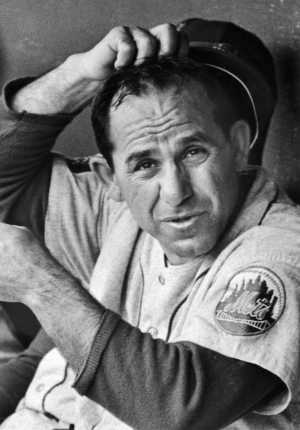
“The Future ain’t what it used to be.”–Yogi Berra

Yogi

Yogi, philosopher extraordinaire, deep in thought

Yogi was right. Literally.

He had absolutely no idea what he was talking about, but he was right nonetheless.  For the way we view the future is directly related to how we view physical reality. Ergo, as our understanding of physical reality changes, so changes how we think about the future.   An entire graduate level lecture could probably be based on this conjecture.  I’ll condense the basic idea to a few paragraphs.

Before Apple, the company, there was apple, the fruit.  And before that fateful day when one of those red orbs conked one Isaac Newton on the noggin, worldviews were simplistic and not generally  based on science.   They were mostly mystical or religious.  Supernatural forces ruled the world and what they had in store for mankind was up to them; it was not to be known by us.  But when the soon-to-be “Sir” Isaac set forth his rules of motion and gravity classical physics was born.  Every action had an equal and opposite reaction, every force and its interaction with mass was theoretically calculable, and therefore predictable.  Newton’s laws ruled physics, and indeed, most science based worldviews for nearly 250 years.

Then two guys named Einstein and Planck came along and screwed up the whole thing.  They were followed by the likes of Heisenberg and Bohr and Schrodinger, who threw the monkey wrenches of quantum mechanics, and most disturbingly, quantum uncertainty, into the mechanisms of physics.  Nothing was ever the same again.**

Just how did these 20th century scientific revolutions, along with chaos and complexity theories, alter the Newtonian worldview?

The Newtonian worldview was deterministic, the post-Newtonian worldview is not.  It was theorized, under Newton’s classical laws, that if one could know the position and momentum of every particle of matter and energy in the universe, then one could know everything that has ever happened and could predict everything that ever would happen in the future.   Quantum mechanics and uncertainty skewered that notion; it killed it stone dead.  As explained in my Quantum Weirdness primers, it is not possible to simultaneously know the exact position and momentum of quantum objects, and interactions of quanta with their environment are only calculable as probabilities. 

In other words, the Newtonian worldview asserted that we could calculate exactly where any particle of matter or energy would be at any time.  The post-Newtonian worldview states that we can only calculate the probability of finding it in a given position at a given time.  The disconcerting part of that last statement is the “finding” part.  For it asserts exactly that, the probability of finding it if we look for it; it does not predict where it is, for until we look it is effectively in every possible position at once.

How does this affect our view of the future and my conjecture that every possible future exists?  In the Newtonian worldview, there is no free will; everything is determined by the existing state of the universe and there is therefore only one possible future.  That would be the one that follows from applying Newton’s laws to the current state of every bit of matter and energy in the universe.  But in the post-Newtonian world, those rules do not work on a quantum level.  Position and momentum are uncertain and results of interactions can only be stated as probabilities.  In a non-deterministic world, free will is enabled and the totality of the future is unpredictable no matter how much data we have to crunch.

Does this future exist?

OK.  Many futures are possible.  But how can I assert that every possible future exists?   I’ll take that up in Part Two of this conjecture.

**It should be noted that while Albert  Einstein, along with Max Planck, laid the foundations of quantum mechanics, he never believed its predictions of uncertainty and randomness.  Perhaps his most famous quotation, “god does not play dice,” refers to this very matter.  He spent much of the last thirty years of his life attempting to find a deeper meaning–hidden variables–that would give the lie to these notions.  He failed and was ultimately proven wrong.  More about this in a future conjecture.

post

In Memorium: Life, Death and Leaves

“Autumn is a second spring when every leaf is a flower”–Albert Camus

Lest the general levity of this blog give you a false impression of my worldview, let me state that sometimes life sucks.  For the most part, I use humor and satire as a defense and an escape, a diversion if you will.   This has been an incredibly bittersweet week; I have never experienced anything remotely like it.   My last post was Freshly Pressed–perhaps the ultimate honor for a WordPress blogger.  Yet while this was going on, three people I know died.  They were an 82-year-old uncle whose death had been anticipated, a 58-year-old work colleague whose demise was an unexpected shock, and most tragically, the 29-year-old son of one of my poker buddies whose death from illness had been feared for some time.

If you will permit me then, a tribute to these lost souls with the only piece of poetry I ever wrote which I would deem publishable.  It’s well over 35-years old–the sort of thing one could only write in one’s youth.

The Leaves

Words ©1976, 2012  Mark Sackler

Sit and look at the leaves,

Amber arms descending from October’s trees.

Covering delicate grasses,

sweeping the highway,

bedding the rain,

Solemn songs to life departed,

Sit and look at the leaves.

post

Quantum Weirdness 104: Heisenberg’s Uncertainty

“Doubt is unpleasant, but certainty is ridiculous.”–Voltaire

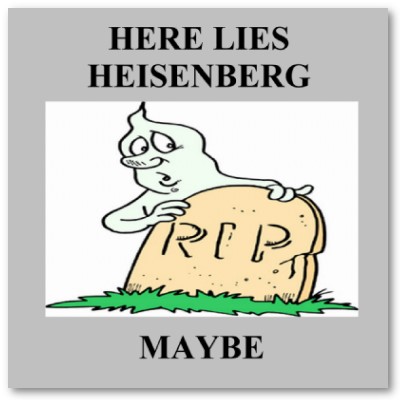
Heisenberg may be dead, but his uncertainty principal is alive and kicking.
(Image credit unknown)

It was the end of the Newtonian worldview.   Early in the 20th century relativity and quantum mechanics created a new scientific outlook on reality–counter-intuitive and downright….well…weird.  The final nail in the coffin of so-called Newtonian determinism was put forth by one Werner Heisenberg in 1927: the uncertainty principle.   Simply stated, you can’t exactly know both the momentum and location of a quantum object.  The more precisely you know one, the less precisely you know the other.   And while recent news headlines suggest to some that Heisenberg has been overturned, this is absolutely NOT the case.   It was thought that the very act of measuring a quantum particle added to the uncertainty, but that was never really part of Heisenberg’s equation–which in fact can also apply to macroscopic phenomena like sound and water waves.  So while a team from the University of Toronto was able to devise a means to measure a quanta (such as an electron or photon) with minimal increase in uncertainty, even they admitted “the quantum world is still full of uncertainty, but at least our attempts to look at it don’t have to add as much uncertainty as we used to think!”

Heisenberg’s principle plays a critical role in something that is rather significant in the foundations of modern philosophy, and as I see it, civilization itself.  That would be how we view the future.  This will be explained in the next conjecture.

Here is a simple video demonstration of the concept by Walter Lewin of MIT–a single-slit experiment.

If you’re brave enough to tackle the math, here is a link to another video from Mind Bites that explains it in terms so simple even I can understand it.  Er…maybe.

post

Vacation Rerun: Quantum Weirdness 102, Equal Time for the Cat

Where’s Waldo?

By the time this post goes winging outward to the vastness of cyberspace,  Cheryl and I will be winging our way home from distant parts unknown. The next new post will return to the subject matter below, so bone up and be ready for brain cramps.

“I don’t like it, and I’m sorry I ever had anything to do with it.”
Erwin Schrödinger  (referring to Quantum Mechanics).

What better follow up to The Equation of Canine Chaos, then the infamous tale of Schrodinger’s Cat?

In Quantum Weirdness 101, we saw that the double-slit experiment revealed the wave-particle duality of sub-atomic quanta, and the fact that these troublesome little bits behave as if they are everywhere they could possibly be at once until an observer looks for them.  While the experimental proof that this happens is rock-solid, the explanation for what causes it is anything but.  For decades after its original discovery in the 1920’s, the predominant interpretation—essentially, in fact, the only one—was the so-called Copenhagen Interpretation.  It essentially states that the universe is just fuzzy on the sub-atomic level, it doesn’t affect our everyday macro-world, and we mortals should not worry about it otherwise.  Critics have said it is really no interpretation, and some facetiously call it the “shut-up-and-calculate” interpretation.   In 1935, Erwin Schrodinger posed perhaps the most famous mind experiment in all of physics to show that theoretically the Copenhagen Interpretation makes no sense.  More recently, physicists have been able to succeed in creating this quantum superposition with larger and larger bits of matter, which tends to shoot empirical holes in Copenhagen.

Anyway, this witty video does a good job of explaining the concept behind Schrodinger’s Cat.  And I’m pretty sure that no cats were harmed in its making—much to the chagrin of my dogs.

(Video Credit: Open University, on You Tube)