post

Time Out: Conrad Cornelius O’Donald O’Dell and the Funniest Names in Children’s Literature

“Said Conrad Cornelius O’Donald O’Dell, my very young friend who is learning to spell…”–Dr. Seuss (On Beyond Zebra)

This post appears today on The Blog of Funny Names

on beyond zebraIt has been previously reported in these pages that this author’s interest in funny names began way back in middle school in the mid 1960’s with the creation of a list of the 50 wackiest names in baseball history.

This report was wrong.   It’s true that my best friend of that era and I did create such a list.   But my seminal interest in funny names lore predated even that,  going way back to elementary school in the late 1950’s.  My favorite book at that age, you see, was an amazing tome by one Theodore Seuss Geisel, AKA Dr. Seuss.

I have often said that while others are encouraged to think outside the box, I have often found it downright difficult to think inside the box, and I’m pretty sure this habit started with the Seuss classic, On Beyond Zebra.   And while an earlier post on this blog chronicled Charles Dickens as the greatest master of funny names in English Literature,  Dr. Seuss deserves similar recognition in the milieu of children’s literature.

I could go on and on regarding any number of Seussian monikers, like Gertrude McFuzz, Ziggy Zozzfozzel or Gerald McBoing-Boing.  But one book stands alone–On Beyond Zebra–as the absolute gold standard of funny names in children’s literature.  In fact, it contained names so outre he invented new letters of the alphabet with which to spell them.

In all 20 new creatures made this alphabet quorum, from YUZZ-A-MA-TUZZ to HIGH GARGEL-ORUM.
For the most part they seemed and sounded quite dumbus, like FLUM is for FLUMMEL and WUM is for WUMBUS.
What is my favorite?  It’s darned hard to picker,  from SNEE is for SNEEDLE to GLICK is for GLIKKER.
And as sure and as shootin’ as I am a libra, my favorite kids book is still ON BEYOND ZEBRA.
 
We often referred to out two schipperkes (dogs) as Thing A and Thing B.  They were almost as raucous as these guys.

We often referred to our two schipperkes (dogs) as Thing A and Thing B. They were almost as raucous as these guys.

And that, my friends, is how it is done.  So come back real soon if you want some real fun.  😀

END NOTE:  A few years ago there were so many hurricanes that the National Hurricane Center ran out of standard western alphabet letters to name them after, and had to go to Greek letters to designate the overflow.  I actually emailed WCBS-New York News Radio 880 weatherman Craig Allen and suggested they use the Seuss letters instead.   To my amazement, he took my tongue-in-cheek suggestion seriously and emailed back that I should send the suggestion to the Hurricane Center.  I shot back that it was intended as a joke, and he should feel free to use it.   I don’t know if he ever did,  but a few days later Stephen Colbert made this very suggestion on the first Colbert Report.  Coincidence?  Maybe, but those New York media types travel in the same circles, so you never know!

 
 
post

Time Out: Lillian Mountweazel and The Incredible Jungftak

Note: The following post appears simultaneously–with a slightly different title–in my monthly guest post on The Blog of Funny Names.

“You could look it up.”–Casey Stengel

Lillian Virginia Mountweazel.  To be or not to be?

Lillian Virginia Mountweazel. To be or not to be?

According to the 1975 edition of the New  Columbia Encyclopedia,   ”Lillian Virginia Mountweazel ( 1942-1973),  was an American photographer, b. Bangs, Ohio. Turning from fountain design to photography in 1963, Mountweazel produced her celebrated portraits of the South Sierra Miwok in 1964. She was awarded government grants to make a series of photo-essays of unusual subject matter, including New York City buses, the cemeteries of Paris and rural American mailboxes. The last group was exhibited extensively abroad and published as Flags Up! (1972) Mountweazel died at 31 in an explosion while on assignment for Combustibles magazine.”

It’s an incredible story–at least, according to the 1975 edition of the New Columbia Encyclopedia– with  ”according to” being the critical phrase. Because, you see, no such person ever existed.  The entry was bogus–a common practice among publishers of dictionaries, encyclopedias and even maps.  It was designed to catch copyright infringement.  This practice was hardly new, as I shall proceed to report.  However, it caused enough of a stir  that The New Yorker coined the term Mountweazel to mean any such copyright trap in published material, and the name has stuck.  As things of this nature often take on a life of their own, the eponymous Ms. Mountweazel now has a page on Facebook and a memorial society on Flickr.

But as odd as this story sounds, the course of events that led me to this discovery is stranger still.  It was a three decade odyssey that started back in the mid-1970′s.  While playing the game of Dictionary at the home of a (much older) friend,  I came across the following in the 1943 edition of Webster’s Twentieth Century Dictionary:

jungftak, n.–a Persian bird, the male of which had only one wing, on the right side, and the female only one wing, on the left side; instead of the missing wings, the male had a hook of bone, and the female an eyelet of bone, and it was by uniting hook and eye that they were enabled to fly, — each, when alone, had to remain on the ground.

That was it; there was no pronunciation and no etymology.

Wow.  I was flummoxed.  How bizarre was this?  I had to find out more.  I went to the local library and searched every encyclopedia and every dictionary, but found nothing.  Figuring that this bird had to be mythical, I next went to books on Persian culture and mythology.  Still nothing.  I was puzzled, but not deterred, and I never forgot this bizarre word and definition.  Over the next several decades I sporadically recalled this incident and searched again, each time to no avail.  No avail, that is, until about five years ago.  Through the miracle know as the internet, the Google search term ‘jungftak’ finally bore fruit.  I uncovered a 1981 article by one Richard Rex in the journal American Speech. He had also discovered this word and had the same issues with it.  His conclusion was that the entry was an early example of what, by the time of this article, had come to be called a Mountweazel.  A copyright trap.  It was quite a letdown, but at least I finally had an answer.

I discussed this phenomenon with Martha Barnette and Grant Barrett as a caller to the NPR show A Way With Words originally broadcast in January of 2010.  You can listen to this archived broadcast here.  My segment occurs about 20 minutes into the show.      Have fun listening, and don’t take any wooden Mountweazels.

post

Tales of a Veterinary Spouse #8: Doggone Pets

“Armadillos make affectionate pets.  If you need affection that much.”–Will Cuppy

“I…discovered you can get used to a man, much like you do a household pet.”–Terry McMillan

There is no greater futility in the Sackler household than to complain about the animals that share our home.   Not their numbers, their habits, their exotic variety nor their ruling of the roost.

“What did you expect?  You married me when I was a veterinary student ,” is invariably the response I get.

Heck, I married a vet; I did not marry the Bronx Zoo.  And , as I often point out,  I was a sportscaster when we met.  This has not kept her from complaining about all the games I watch on TV.  The least she could do is accept it and keep the chips and dip coming during the NFL playoffs.

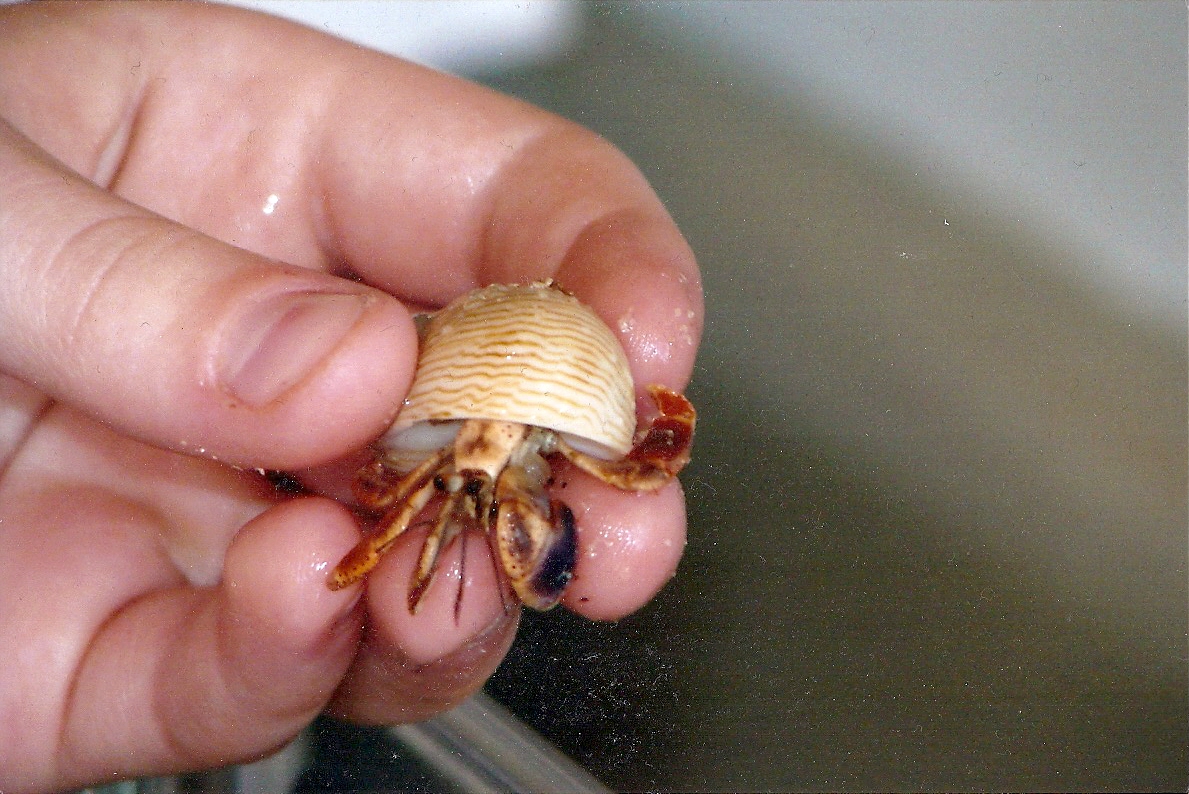
Hermit crab.  You'd be a hermit, too, if you looked like this.

Hermit crab. You’d be a hermit, too, if you looked like this.

But I digress.  Our current pet count is nine, a rather typical number.  Six dogs in the house, two horses in the paddock, and one cat in the barn, appropriately named Barney.  In the past, our  critter count has numbered as high as 17 at one time, and not all of them with four legs.  Critter is an appropriate term, as it is a rather extreme stretch of the imagination to call some of them pets.   These have included rabbits, hedgehogs, guinea pigs, guinea fowl,  turkeys–both domestic and wild–chickens, hermit crabs a gecko and a donkey.  We’ve also had visits from–but thankfully not made homes for–an iguana, a boa constrictor, an African millipede and Madagascar hissing cockroaches.  The variety, and the stories that go with them are never ending.

One of the earliest tales  dates to our first apartment during Cheryl’s years in veterinary school.   We had a visit from a very special friend, Kate–the very woman who had introduced us in the first place.   She entered to find us in a frenzy.

“We can’t find Archibald.  Archibald got lose.  Help us find Archibald!”

Kate was all too happy to comply and began scouring the premises with us.  She looked under the couch, behind the dresser and basically mimicked whatever searching patterns she saw us following.

Ten minutes into this, she suddenly stopped, and stared at both of us with a quizzical look.

“Um, excuse me for asking, but what are we looking for?  What exactly is Archibald!?”

A good question, if a bit late for the asking.  Archibald was  a tiny hermit crab.  And it was Kate who ultimately found him–once she knew what she was looking for, the quest was not so daunting.

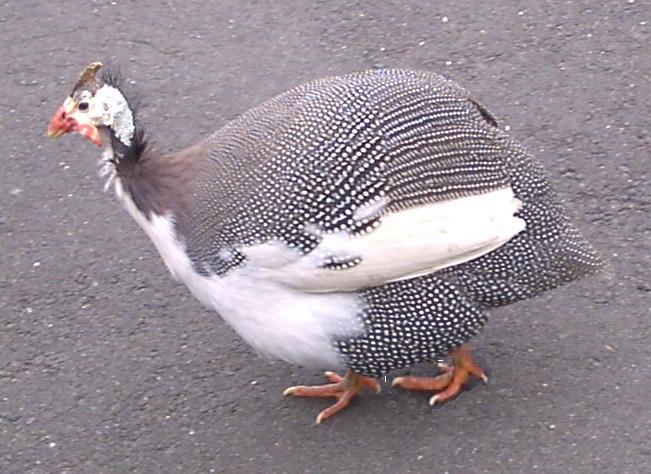
Guinea Fowl.  Proof that god has a sense of humor.

Guinea Fowl. Proof that god has a sense of humor.

From my perspective though, the most annoying of these fauna have been those that shatter the calm with odd and unusual calls.  Screeches, brays, cock-a-doodle doos.  The Guniea fowl screamed bloody murder during their spring mating season.  The first spring we had them, they did this while stampeding on the roof over our heads in the middle of the night.  Fun.   A donkey and a rooster on our premises made noises, while I worked from a home office, that must have sounded to my customers on the phone as if I was selling grain out of a silo in Iowa.   More on these lovely experiences in a future installment;  in the meantime, step a way from the barn.  You never know for sure what might be in there.

post

Oh Brother(s), Where Art Thou, the Charlos and Arroyos

I admit it, holidays left me in a lazy blogging fog. One more reblog–my monthly guest post on The Blog of Funny Names–and I promise to get back on track. Eventually.

Mark Sackler's avatarThe Blog of Funny Names

“I grew up with 6 brothers.  That’s how I learned to dance–waiting for the bathroom.”–Bob Hope

“Big sisters are the crabgrass in the lawn of life.”–Linus (Charles M. Schultz)

When it comes to siblings in major professional sports, a few names  immediately come to the minds of today’s fans.  The Manning Brothers.  The Williams Sisters.  The Molina Brothers.  The Klitschko Brothers.

Yes, they come to the mind of the everyday sports fans–but we at The Blog of Funny Names set a higher standard.  When it comes to siblings with funny names, two pairs of boxing twins(yes, twins!) stand out above the crowd.  So let’s investigate.

Jermell and Jermall Charlo are identical  twins born one minute apart in LaFayette, LA in 1990.  Wow–it’s hard enough to tell identical twins apart–their parents had to give them practically identical names, too?  They are both undefeated professional boxers in the light middleweight division.  Jermell…

View original post 306 more words

post

Cosmic Quote #33

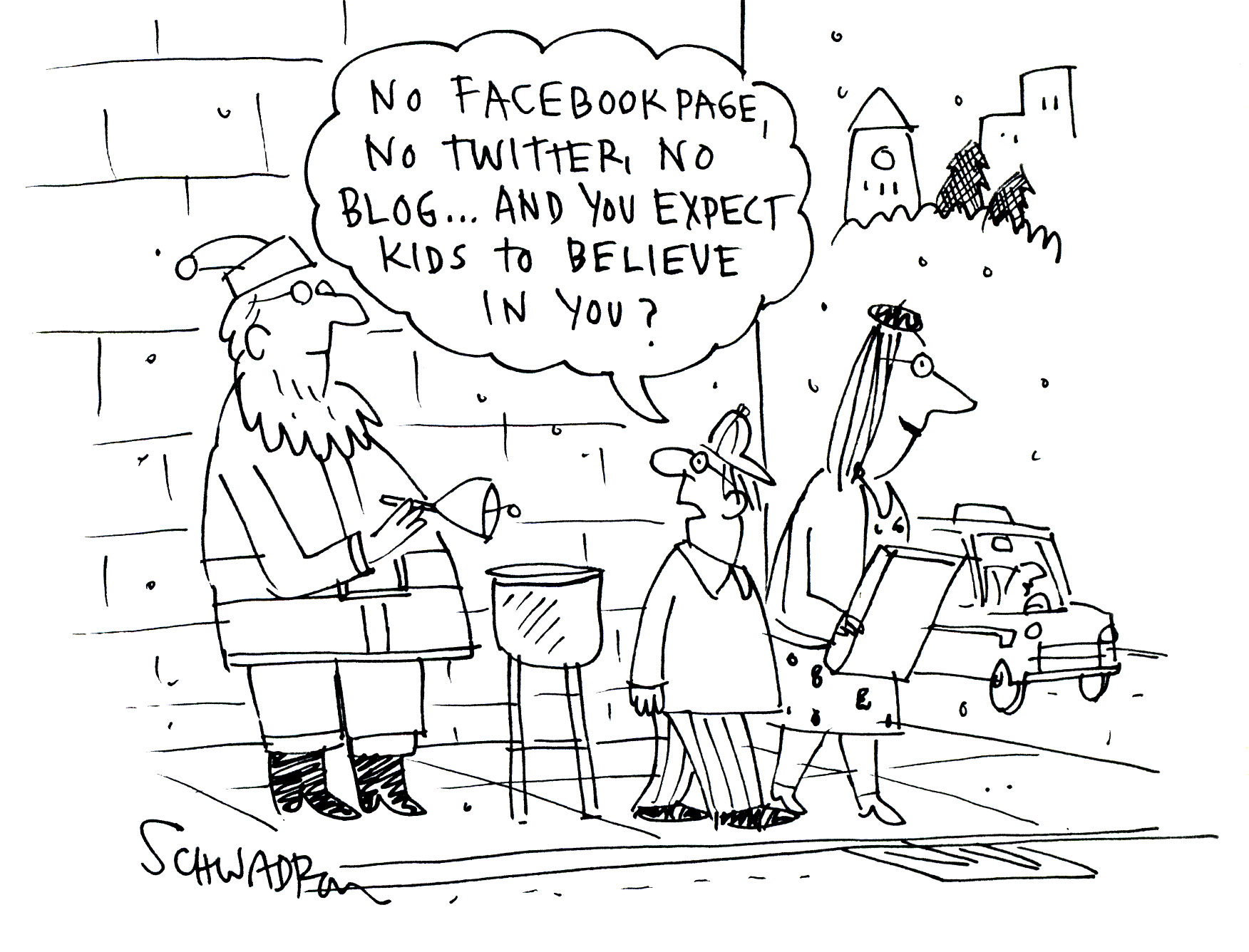
“Santa has the right idea. Visit people once a year.”–Victor Borge

Or don’t visit anyone at all.  Just blog.  Thanks for visiting me here, have an enjoyable holiday season and a prosperous 2014.

post

Cosmic Quotes) #29

“Science is magic that works.”-Kurt Vonnegut

“Any sufficiently advanced technology is indistinguishable from magic.”–Arthur C. Clarke

www.cartoonstock.com Used with permission

http://www.cartoonstock.com Used with permission

If I could write like Clarke or Vonnegut, that would be indistinguishable from magic.  The fact that I can still get up in the morning–or most mornings, anyway–that is magic.  Now if that little fairy to the left would only tell me what to write next…

post

Photo Op #6: The U.S. Open

“This taught me a lesson, but I’m not quite sure what it is.”–John McEnroe

“I smile a lot, I win a lot, and I’m really sexy.”–Serena Williams

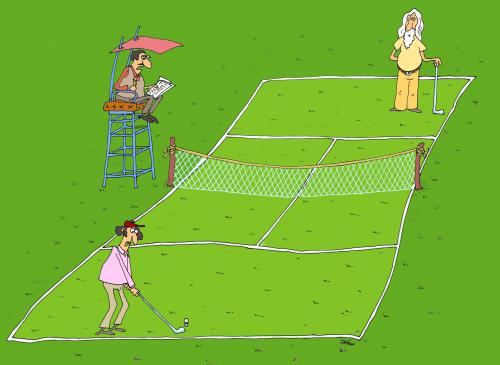
My golf AND tennis games feel like this sometimes.

My golf AND tennis games feel like this sometimes.

Check off another bucket list item.  I finally spent a day at the U.S. Open tennis championship, on Tuesday, September 3.  It taught me a couple of things, and unlike John McEnroe, it think I know what they are.

The first is, what in the world was I waiting for?  I should have done this years ago, considering I live only about 65 miles (or 100km) from the Billie Jean King Tennis Center.  The second?  If’ I’m going to take pictures, maybe I should bring something more advanced than my iPhone 4.  Yes, I actually am considering the upgrade to the 5S based on the reviews I’ve read of the camera.  In spite of my previous post, I’m betting I can’t  get any more distracted than I already am.  Take a look at the following images and then take the poll to provide me with your opinion of what I should do for a camera if I go next year.  Oh, as far as the question of Serena being sexy, we’ll keep those opinions to ourselves.

.

.

The view from my seat from the loge in Ashe Stadium. The iPhone 4 picture only makes it look like nose bleed territory.

The view from my seat from the loge in Ashe Stadium. The iPhone 4 picture only makes it look like nose bleed territory.

.

.

.

THE DRAW

THE DRAW

.

.

The top seeded women's doubles team of Errani and Vinci going about their business.

The top seeded women’s doubles team of Errani and Vinci going about their business.

OK.   So now, tell me what I should do for capturing images if I go to open next year.

post

Quantum Weirdness 107: Bell’s Inequality

Note:  I said in Quantum Weirdness 106 that I was done with this series for now.  There are two possibilities here.  Either my definition of “for now” is a very short time, or I have branched off into an alternate universe where the term “done for now” has no meaning.**  Then again, I could have branched off into an alternative universe where, instead of writing this post, I would be lying on a Mediterranean beach next to a super-model in a string bikini.   I wish.

**Okay, I might just have have lied.

“God does not play dice.”–Albert Einstein

“Quit telling god what to do.”–Niels Bohr

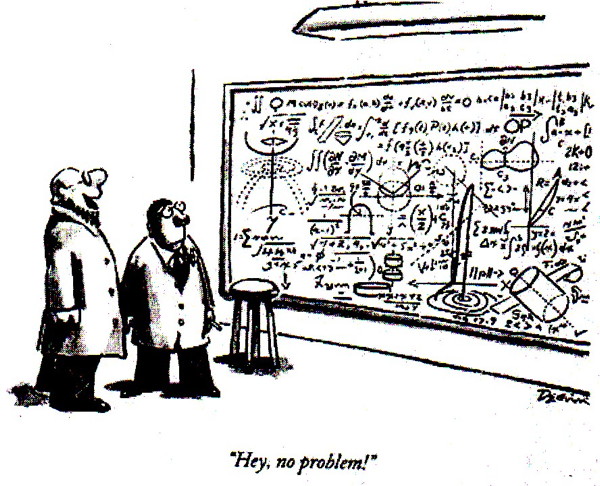
It’s complicated.  And this just about reaches the limit of my own understanding.

The whole point of Einstein’s comment is that he could not accept the random nature of the quantum world.  He could not accept that quanta of matter and energy, and all their itinerant properties, only exist as probabilities until we observe  them.  He felt that there must be hidden variables that gave them these properties whether anyone was watching or not.  “I’d like to think the moon is there whether I am looking or not,” he said.

He was wrong.  Well, I don’t know about the moon, as that invokes the infamous Schrödinger’s Cat problem and it’s obfuscation of the Copenhagen Interpretation.  But for those tiny little quantum bits of stuff, it seems as if he blew it.

It all boils down to two papers.  The first was a 1935 paper by Einstein, along with colleagues Nathan Rosen and Boris Podalsky that proposed a thought experiment to demonstrate that there are only two possible explanations for certain properties of quantum mechanics: either there are hidden variables governing the quantum world, or else, as Einstein called it “spooky action at a distance.”  This has become known as the EPR paradox.

The second was a 1964 paper by John S. Bell, proposing an equation and related experiment that could be used to determine which of the alternatives is correct.  This became known as Bell’s inequality.

The technology did not yet exist, though, to make the measurements required to determine the solution to Bell’s equation. That did not occur until Alain Aspect, et al, performed an experiment in 1981 that proved, finally, that Einstein was wrong: no hidden variables exist; it’s spooky action at a distance.  At least, that is,  until further notice.

A  fairly facile explanation of the concepts and history is available here (including a brief touching on their relationship to Schrödinger’s Cat) and some subsequent contrary opinions here.  Or for those who can’t (or prefer not to) read, see the video that follows.  Confused?  One of the greatest scientific minds of the 20th century, Richard Feynman, said that nobody understand quantum mechanics.  Boy, does that give me free rein to get crazy with conjecture #5: Quantum Solipsism.   There may actually be a universe where I finally write and post it.

Whew.

post

Quantum Weirdness 103: How Many Worlds?// Summer Rerun

“He who laughs has not yet heard the bad news.”–Bertold Brecht

The good news is, this is the last of the current series of summer reruns.  The bad news is, that means vacation is over and I have to go back to work.  Grumble.

“There is no question that there is an unseen world. The problem is, how far is it from midtown and how late is it open?” –Woody Allen

For the quantum physics-uninitiated, get ready for the weirdest of the weird: the many worlds interpretation of quantum mechanics.

In Quantum Weirdness 101, we talked about the wave-particle duality of sub-atomic quanta, and how they appear to be in a superposition of every possible trajectory and location until an observer measures them.

In Quantum Weirdness 102, we discussed The Copenhagen Interpretation, which basically states that reality is just fuzzy on that level.  They are only potential trajectories–probabilities–interfering with each other, and this doesn’t have a measurable effect on our everyday macro world.   But we also visited Schrödinger’s infamous cat–the mind experiment that poked a colossal hole in  Copenhagen.

Image Credit: University of Oregon, 21st Century Science

The Copenhagen interpretation remained the most popular explanation for decades, in spite of Schrödinger.   But in 1957 cosmologist Hugh Everett made an astonishing proposal.  He suggested that the particles themselves–not merely their probabilities–interfere with one-another.  In this interpretation, they actually take every possible trajectory, each in an alternate universe.  Effectively every physically possible history exists in a huge–possibly infinite–number of alternate universes. So when we look in the box containing that possibly dead or alive cat it is actually in two universes: alive in one, dead in the other.   We just see it in the one we are in.   Taken to the extreme, every one of us would exist in a countless number of alternate universes.   Some would be imperceptibly different from ours, in others we might not even recognize ourselves or the the world around us.  And while Everett was mostly ignored or derided in his day, his many worlds interpretation has become a leading explanation of quantum weirdness, rivaling even Copenhagen.

So where do I stand?  Agnostic.  It is a rather optimistic world view.  I hope it’s true; I’m afraid it isn’t.  But many of the world’s top physicists now lean towards many worlds, and David Deutsch, among others, makes some very convincing arguments using deductive reasoning if not direct evidence.  I will leave it at this: it is a strong possibility that greatly influences my millennium conjectures. For more detailed background, check out the Wikipedia articles on The Many Worlds interpretation,  as well as general overview of quantum mechanics interpretations.   Or if you prefer, here is an entertaining video, shamelessly lifted from YouTube.

post

The Sackler Laws #4: The Law of Political Activism

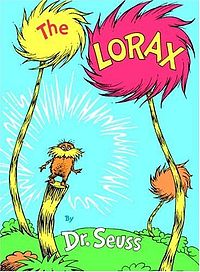
“Unless someone like you cares a whole awful lot, things are not going to get better.  They’re not.”–Dr. Seuss, The Lorax

“If god had not intended us to eat sugar, he wouldn’t have invented dentists.”–Ralph Nader

Note:  In general, I have avoided the controversies of religion and politics in this blog, though there have been hints at my views on both.  This post tiptoes dangerously towards the precipice of both, though it clearly points no finger at any specific political or religious viewpoint.  I’m bound to get flamed, anyway.

For the fourth and final** installment of the Sackler Laws, I bring you Law #4: The Law of Political Activism.  This is not to be mistaken for Law #1, The Law of Bumper Sticker Activism.  On the other hand, maybe it should be.  Both have to do with taking a good thing too far.  It is simply stated:

First class activists remain forever activists.  Second class activists run for office.

The greatest first class activists of all time, if you look at it carefully, rarely if ever ran for office.  Think Gandhi, Martin Luther King and Susan B. Anthony.  Yes, it’s true that great activists for freedom such as Nelson Mandela and Lech Walesa ultimately became president of the entities their activism wrought; but they were effectively drafted by popular acclaim that arose from the ultimate success of their leadership, they did not attempt to become politicians.

As a primary example of the type of second class activist I present to validate this law, I give you two words.

Ralph Nader.

Here is a guy who pissed off half the country–mostly the corporate world and the Republican right–with decades of pain-in-their-asses activism and left-wing proselytizing.  Then he ran for president on a 3rd party line and pissed off most of the other half of the country.  His siphoning of votes from the left in 2000 almost certainly enabled the election of the candidate most diametrically opposed to his beliefs.  Not satisfied with having made the world, as he saw it, worse, he ran again in 2004 just to thumb his nose at those that might have otherwise been his ally.

That’s about all there is to that.  The only one thankful to him, other than a few diehard loyalists, is me, if only because he gave me the best real world validation I’ve ever had for this aphorism.

But the question then arises.  If we know what a second class activist looks like, what does a third class activist look like. That one’s even easier.

Robertson

Robertson

Sharpton

Sharpton

And you were wondering how I would manage to piss off the religious nuts as well?  If you want inspiration for political activism, the Dr. Seuss quote above is a good place to start.  If you want religious inspiration–you’ve come to the wrong place.

200px-The_Lorax

**Nothing is final except death and…well, except death.  This will only be the final installment of the Sackler laws if I die before thinking up another one.

Signature       @MarkSackler