post

Quantum Weirdness 107: Bell’s Inequality

Note:  I said in Quantum Weirdness 106 that I was done with this series for now.  There are two possibilities here.  Either my definition of “for now” is a very short time, or I have branched off into an alternate universe where the term “done for now” has no meaning.**  Then again, I could have branched off into an alternative universe where, instead of writing this post, I would be lying on a Mediterranean beach next to a super-model in a string bikini.   I wish.

**Okay, I might just have have lied.

“God does not play dice.”–Albert Einstein

“Quit telling god what to do.”–Niels Bohr
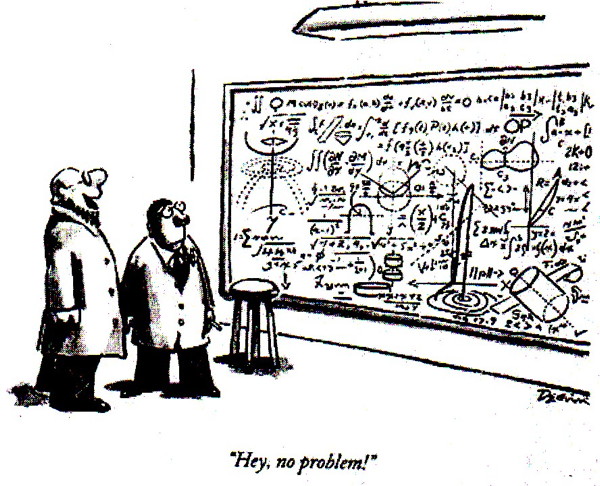
It’s complicated.  And this just about reaches the limit of my own understanding.

The whole point of Einstein’s comment is that he could not accept the random nature of the quantum world.  He could not accept that quanta of matter and energy, and all their itinerant properties, only exist as probabilities until we observe  them.  He felt that there must be hidden variables that gave them these properties whether anyone was watching or not.  “I’d like to think the moon is there whether I am looking or not,” he said.

He was wrong.  Well, I don’t know about the moon, as that invokes the infamous Schrödinger’s Cat problem and it’s obfuscation of the Copenhagen Interpretation.  But for those tiny little quantum bits of stuff, it seems as if he blew it.

It all boils down to two papers.  The first was a 1935 paper by Einstein, along with colleagues Nathan Rosen and Boris Podalsky that proposed a thought experiment to demonstrate that there are only two possible explanations for certain properties of quantum mechanics: either there are hidden variables governing the quantum world, or else, as Einstein called it “spooky action at a distance.”  This has become known as the EPR paradox.

The second was a 1964 paper by John S. Bell, proposing an equation and related experiment that could be used to determine which of the alternatives is correct.  This became known as Bell’s inequality.

The technology did not yet exist, though, to make the measurements required to determine the solution to Bell’s equation. That did not occur until Alain Aspect, et al, performed an experiment in 1981 that proved, finally, that Einstein was wrong: no hidden variables exist; it’s spooky action at a distance.  At least, that is,  until further notice.

A  fairly facile explanation of the concepts and history is available here (including a brief touching on their relationship to Schrödinger’s Cat) and some subsequent contrary opinions here.  Or for those who can’t (or prefer not to) read, see the video that follows.  Confused?  One of the greatest scientific minds of the 20th century, Richard Feynman, said that nobody understand quantum mechanics.  Boy, does that give me free rein to get crazy with conjecture #5: Quantum Solipsism.   There may actually be a universe where I finally write and post it.

Whew.

post

Quantum Weirdness 103: How Many Worlds?// Summer Rerun

“He who laughs has not yet heard the bad news.”–Bertold Brecht

The good news is, this is the last of the current series of summer reruns.  The bad news is, that means vacation is over and I have to go back to work.  Grumble.

“There is no question that there is an unseen world. The problem is, how far is it from midtown and how late is it open?” –Woody Allen

For the quantum physics-uninitiated, get ready for the weirdest of the weird: the many worlds interpretation of quantum mechanics.

In Quantum Weirdness 101, we talked about the wave-particle duality of sub-atomic quanta, and how they appear to be in a superposition of every possible trajectory and location until an observer measures them.

In Quantum Weirdness 102, we discussed The Copenhagen Interpretation, which basically states that reality is just fuzzy on that level.  They are only potential trajectories–probabilities–interfering with each other, and this doesn’t have a measurable effect on our everyday macro world.   But we also visited Schrödinger’s infamous cat–the mind experiment that poked a colossal hole in  Copenhagen.

Image Credit: University of Oregon, 21st Century Science

The Copenhagen interpretation remained the most popular explanation for decades, in spite of Schrödinger.   But in 1957 cosmologist Hugh Everett made an astonishing proposal.  He suggested that the particles themselves–not merely their probabilities–interfere with one-another.  In this interpretation, they actually take every possible trajectory, each in an alternate universe.  Effectively every physically possible history exists in a huge–possibly infinite–number of alternate universes. So when we look in the box containing that possibly dead or alive cat it is actually in two universes: alive in one, dead in the other.   We just see it in the one we are in.   Taken to the extreme, every one of us would exist in a countless number of alternate universes.   Some would be imperceptibly different from ours, in others we might not even recognize ourselves or the the world around us.  And while Everett was mostly ignored or derided in his day, his many worlds interpretation has become a leading explanation of quantum weirdness, rivaling even Copenhagen.

So where do I stand?  Agnostic.  It is a rather optimistic world view.  I hope it’s true; I’m afraid it isn’t.  But many of the world’s top physicists now lean towards many worlds, and David Deutsch, among others, makes some very convincing arguments using deductive reasoning if not direct evidence.  I will leave it at this: it is a strong possibility that greatly influences my millennium conjectures. For more detailed background, check out the Wikipedia articles on The Many Worlds interpretation,  as well as general overview of quantum mechanics interpretations.   Or if you prefer, here is an entertaining video, shamelessly lifted from YouTube.

post

Quantum Weirdness 101: Observer Created Reality//Summer Rerun

“It gets boring at home.  How many reruns of Abbott and Costello movies can a guy watch on TV?”–Bud Abbott

It’s summer vacation time, and that means reruns.  For the next couple of weeks I’ll be reprising some oldies but goodies.  I’ll intersperse the sublime and ridiculous, as always.  Let’s start with a Quantum Weirdness review in preparation for my next blockbuster conjecture, which might actually be published before the fall.

Quantum Weirdness 101:  The Double-Slit Experiment

“Anyone who is not shocked by quantum theory has not understood it.”–

Neils Bohr

With apologies to Douglas Adams–don’t panic!  Although an understanding of a few basic concepts of quantum mechanics will be helpful in following some of the Millennium Conjectures, it’s actually not that hard to grasp.  No math is needed.  The following video gives a clear and entertaining description of the wave-particle duality of the sub-atomic world.   If you weren’t already familiar with the concept, this should give you what you need to “get it.”   What it won’t allow you to do is come to grips with it, or even believe it.  But you’d better believe it.  Quantum theory is one of the most rock solid, experimentally verified fields in all of science.   And whether you believe it or not, don’t even think of explaining it.  The world’s most brilliant physicists have been debating the implications for decades and are nowhere near a consensus.   If you’d like a little more after the video, including a description of some of the leading explanations, here is a text primer.

post

Cosmic Quote #23: Happy Birthday MC

“I seldom end up where I wanted to go, but I almost always wind up where I need to be.”-Douglas Adams

“There still is no cure for the common birthday.”–John Glenn

The Millennium Conjectures™ turns one today.  On May 23, 2012 my life was in turmoil.   My father had just passed away,  one of my best friends was in the process of being diagnosed with an incurable cancer and I was feeling more than a bit burned out.  Was this the cure?  Life still has its vicissitudes, but I am certainly doing a lot better than a year ago.   This blog has helped, and it has survived.   To paraphrase Douglas Adams, it hasn’t always gone where I thought it would go, but it has always gone where I needed it to be.  Amazingly,  I have amassed a decent sized audience and have received no death threats or arrest warrants.   And as there is no truism greater than the John Glenn quote above, I will relentlessly keep going where I need to be, as long as I am still breathing.   Below is the first post from one year ago today.  Where has it taken me?  Where has it taken you?

Signature        @MarkSackler

.

May 23, 2012:  What is This?

These are my musings, both ridiculous and sublime.  I would have made “Ridiculous and Sublime” the primary title of this blog, but I am vain.  I want some semblance of uniqueness and there are many other bloggers using this theme.   But I will explain both title and subtitle before proceeding.

So what are Millennium Conjectures?  I’ll explain that in a bit as well.  But first, I present a word about the overall content and nature of my posts.  And why I, and my posts, are both ridiculous and sublime.

This is not a personal journal.  Who would be interested in reading my personal journal online?  I wouldn’t even be interested.  No, these are musings, observations and conjectures from a journalistic standpoint, a way of looking at things you might find interesting or funny.  You might also find some silly and trivial.  I do have some past background in both broadcast and print journalism, but that is not my professional livelihood these days; I do this for the satisfaction and outlet.

So—I’ll get back to the subtitle.

Let’s face it: I am both ridiculous and sublime.  To start with, the two most famous people whose birthday I share (October 2) are Mohandas Gandhi and Groucho Marx.

Gandhi

What could be more sublime and ridiculous than those two?  And to boot, the most famous thing, arguably, that happened on the very day of my birth (Oct 2, 1950), was the appearance of the very first syndicated Peanuts cartoon.  Good ‘ol Charlie Brown was born the same day as me.  He is most certainly a perfect blending of the two qualities we are talking about.  Wishy-washy? Maybe. But that is only because he is so torn by these conflicting aspects of the universe that surrounds him.  Yes, the silly and profound seem both to be bound into my DNA.

Content herein will then consist of both the trivial/silly (WheresGeorge.com, history of CT license plates, Pearls Before Swine) and the profound (Quantum Physics, Cosmology, Existentialism, Opera and the philosophy of science).  There will also be topics that engender a bit of both characteristics; baseball, for example, and especially baseball statistics.  Yes, Baseball is a game, but as George Will so astutely observed, “if baseball is just a game, then the Grand Canyon is just a hole in the ground.”   This will happen solely because my cluttered mind embraces all of these endeavors, and for some strange reason, I think that somewhere out there one or two people might be interested in my insights.

So, back to the Millenium Conjectures.  My posts will be marked as either Ridiculous or Sublime or Ridiculous AND Sublime.  The lion’s share of the Sublime category—indeed of all the content– will be a series I call The Millenium Conjectures.  These will deal with my views and speculations on the nature of reality, the universe and  scientific philosophy.  Everything else will be a time-out to blow off steam. But lest my head explode, let alone yours, this is enough for now.

Text in this post ©2012 Mark Sackler

post

Cosmic Quote #22

“I like physics, but I love cartoons.”–Stephen Hawking

Who knew Hawking had such a sense of humor.  No wonder he hasn’t won a Nobel Prize.  Remind me to introduce him to Stephan Pastis; they might like each other, as the strip below suggests.

This one reads like it was written for Hawking!

This one reads like it was written for Hawking! (click for full image)

(Previously published in my review of Pearls Before Swine. Cartoon ©2012 Stephan Pastis)

.

.

Signature

@MarkSackler

post

Conjecture #4: Quantum Consciousness

“You can’t always get what you want.  But if you try sometime, well you just might find, you get what you need.”–The Rolling Stones (Jagger/Richards)

“I’m-a get medieval on your ass.”–Marcellus Wallace (character, Pulp Fiction)

I conjecture:  In a quantum multiverse, one’s consciousness is a composite of the many worlds.


You’ve been warned folks: I’m-a get metaphysical on your asses.  What’s worse, it’s a personal, almost solipsistic metaphysics.  Hell, it’s my blog, why can’t I?  I might also add that the next couple of  conjectures will be the most controversial, and to some extent they might contradict each other.  Consider it an appropriate quantum superposition–both simultaneously half true.

Few subjects in the sciences are as controversial as the notion of quantum consciousness, as it meets at the junction of theoretical physics and cognitive psychology, and manages to merge the two phenomena that puzzle scientists the most.  Oh, we understand what quantum mechanics is in terms of what it does,  but have no freakin’ idea how and why it does it.   You can say pretty much the same for consciousness.

The concept of quantum consciousness is nothing all that new.  Without getting too technical–because hey, then I wouldn’t understand it either–the notion of a quantum mechanical basis for human consciousness was first directly proposed by Roger Penrose, in his 1989 book, The Emperor’s New Mind.  Built on his earlier work with Stuart Hammerhoff,  Penrose asserted that the human mind can perform functions that are not computable and could only arise from quantum superpositions occurring within the brain.    Max Tegmark,  an MIT cosmologist with no shortage of his own controversial ideas, became the most vocal opponent of this concept, for reasons I won’t go into here, as this is not exactly what I am advocating.     Or maybe it is.

What I am advocating, whether the mind is a quantum computer or not, is that our conscious experience represents a composite of all the universes, or potential universes suggested by quantum theory.  The distinction between potential and actual alternate universes implies the distinction between the Copenhagen and Many Worlds interpretations of quantum mechanics.  And the former seems to make more sense in concert with this conjecture, as it asserts that there simply is no objective reality on the sub-atomic level until we measure it; there are, effectively, only statistical probabilities.  From that it would be easy enough to make the philosophical assertion that our consciousness is essentially a composite of all the possibilities.

But it might not be.  As we only appear to be conscious in one reality at a time, it is certainly within the realm of feasibility to assert that consciousness is a composite in the Many Worlds scenario as well.   If the Many Worlds interpretation is willing to accept that these universes can interact with each other on the sub-atomic level to produce the wave interference pattern described in Quantum Weirdness 101,  why not accept that our consciousness does the same thing? Therefore, consciousness would be a composite across actual, physically real worlds.  David Deutsch, in his book The Fabric of Reality, makes the case that the quantum multiverse is the enabler of free will;  from this I would infer he means consciousness as well.  But the Many Worlds interpretation suggests something perhaps darker and more sinister,  even frightening.  I’m bound to get flamed to no end for even bringing it up–it will be the subject of Conjecture #5.  I call it quantum solipsism.

My bottom-line position on the composite consciousness conjecture: It’s a strong possibility.  I see evidence of it in my own life; but it would take a volume, let alone a blog post, to fully recount.  The best way to sum it up?  The Rolling Stones quote above.  It seems I rarely get exactly what I want, but often get what I need, and just in the nick of time.  What?  You say you don’t get what you need?  Well, read the next conjecture.  It seems that may not be my problem!

Below, Stuart Hammerhoff discusses the notion of quantum consciousness and related issues.

post

Cosmic Quote #18

“Quantum mechanics is magic.”–Daniel Greenberger.

Image credit: Matthias Giesen http://matthiasgiesen.wordpress.com/page/8/

Image credit: Matthias Giesen http://matthiasgiesen.wordpress.com

Quantum mechanics.  Niels Bohr said if you’re not shocked by it, you don’t understand it.  Richard Feynman said nobody understands it.  Albert Einstein said god does not play dice. Stephen Hawking said god does play dice and sometimes he hides the results.  I say who the hell cares, as long as they give me fodder for my blog.  Or my wife’s horse.  Or my accountant’s newt.  It all fills  space, thus proving the vacuum is not empty.  Isn’t physics fun?  [Note: vacuum is one of the few words in the English language containing “uu.”   But it’s not as cool as muumuu, duumvir or menstruum, proving that linguistics is fun, too.]

post

Quantum Weirdness 106: Are dreams real?

 “Reality is wrong.  Dreams are for real.”–Tupac Shakur

It has been advocated–I can’t recall by whom–that our sleep dreams may actually be real events in an alternate universe.   I doubt it;  that’s too far over the top for my taste.  But the following unusual dream–one I’ve actually had–will serve for now as my final installment of the Quantum Weirdness Primer.   It’s a fitting intro to my next two conjectures, both of which deal with the possible nature of consciousness in relationship to quantum physics.  The dream was short and unexciting, but opened up a Pandora’s box of questions.

The Infinite Office Building

The Flatiron building as it appeared around the time of my father's birth in 1919.  It wasn't actually in the dream, but it's just too cool not to include.

The Flatiron building as it appeared around the time of my father’s birth in 1919. It wasn’t actually in the dream, but it’s just too cool not to include.

I am working in an art-deco era office building in the Flatiron District of Manhattan.  It is a beautiful, clear spring day and the New York skyline fills my panoramic view.  I get up to go to the water cooler when a realization hits me.  This is an infinite office building with an infinite number of floors.  Every floor represents an alternate universe–an infinity of them.   Every possible universe that I could, or possibly do exist in, is here.   I ponder the implications and head toward a back staircase to explore.  Which way should I go? Up or down?  Where will it bring me?  But a chilling thought hits me just as lift my hand to open the exit door leading to the stairs.  What if I can’t find my way back?  Sure, this specific universe that I currently exist in must reside somewhere within an infinity of universes.   But by definition, if I explore starting from this one, there will always be a finite number behind me and an infinite number ahead of me.  I would likely never find my way back within my lifetime, or perhaps even an infinite number of lifetimes.  I lower my hand, go back to my office,  and wake up.

The dream is reminiscent of David Hilbert’s concept of the Infinity Hotel, an explanation of which is in the entertaining short video below.  Strangely enough, I first heard of this idea two weeks after having the Infinite Office Building dream, when I read about it in detail in David Deutsch‘s The Beginning of Infinity.  In any case, the conclusion I reached from my hesitance to explore, was a realization that maybe it really doesn’t matter how many potential or actual universes there are if we are only conscious in one.  Or one at a time.  Or does it?  I’ll discuss these enigmas in my next two Millennium Conjectures, after a finite number of intervening posts.   [Video credit: TED Ed]


post

Equations of Everyday Life#3: Media Attention Span (Part One: The Media–illogical Constant)

“It was my biggest blunder.”–Albert Einstein on his cosmological constant concept.

You have to love ‘ol Albert.  It’s not that he admitted he was wrong.  It’s that he turned out to be wrong about being wrong. In other words, the cosmological constant turned out not to be such a big blunder after all.  He thought that there must be a force in the universe that counteracts gravity and prevents a static universe from contracting on itself.  In 1917 he dubbed it the cosmological constant.  Then came Hubble’s discovery in the 1920’s that the universe is expanding, which was closely followed by the big bang theory (the actual theory, not the TV show), and out the window went Einstein’s constant.   But then, in 1998, it was discovered that the expansion of the universe is accelerating and–bingo!–the cosmological constant, now referred to as dark energy, was reborn.

So what the hell does this have to do with the current equation?  It’s also a constant, and it might turn out that it is as slippery and elusive as dark energy.  The difference though, is that this one describes contraction, not expansion; more specifically, the contraction of media attention over time as pertains to inane celebrity behavior.  I call it:

The Media-illogical Constant

If you’ve had any physics education, you’ve certainly heard of the inverse square law.  It applies to any number of physical properties, gravity, light, radio waves, sound or the attention level of undergraduates to a lecture in a large hall.  Simply stated, as one travels away from the source, the intensity of the force or signal decreases by the inverse of the distance squared.  A similar equation can describe the rate at which our tabloid-minded western media lose interest in stupid celebrity hijinks.  The equation is the same as the inverse square law with one modification:  just substitute time for distance.    Quite simply, it looks like this: 
inverse squareIn plain English:  the intensity of the media attention is proportionate to the inverse of the time since the story’s emergence to national (or international) attention, squared.  So when Lindsay Lohan gets arrested–yet again–the media attention four days after the story will be 1/16th of what it was when the story broke.  [Are you are wondering why this equation just doesn’t use an equal sign instead of a proportional to sign? It beats me.  But one immutable rule of these posts is to always use the coolest looking symbol possible.]
.
There are, of course, caveats–aren’t there always?  This theoretical pronouncement exactly works, if, and only if, there is no significant obstruction or interference from other media events, whether or not they involve inane celebrities.  This is the same as applies to physical properties measured with the inverse square law.    Place a brick wall between the light source and your measuring device and all bets are off.  Likewise,  a bigger story may come along and completely drown out whatever Lady Gaga has been up to lately.   I have a name for this phenomenon and resulting calculations–pretty cheeky of me since I haven’t even invented it yet.  I call it The Big Bust Theory.   Depending on the stories involved, this may or may not be a double entendre.  Either way, part two of this post will deal with that equation.  It’s coming soon to a blogoshere near you.
post

Cosmic Quote #11

“If people think nature is their friend, then they don’t need an enemy.”–Kurt Vonnegut

Image credit: CartoonStock.com. Used by permission

Clearly, anyone who took the brunt of Sandy can identify with that quote.  Hurricanes, tornadoes, earthquakes, droughts, tsunamis.  Nature packs plenty of punches.  Wait, you mean it’s organic foods and natural remedies you embrace? OK, I’ll counter with hemlock, radon, arsenic, curare. Good grief, there are easily as many natural ways on this earth to kill us as their are to enhance us.  And most of the rest of the universe would kill us in an instant.  Sure, there is plenty of beauty and benefit in nature.  But anyone who hasn’t grasped the implications of the second law of thermodynamics hasn’t a clue what nature really is–or how amazing it can be.