post

Winter rerun: This is Not a Pipe

While I’m out photographing the Spanish countryside today, here’s an apropos rerun of one of my back posts.  What else can I say–other than “this is not a blog?”  

“I am two with nature.”–Woody Allen

This is not a pipe

The Treachery of Images, by Rene Magritte, 1928-29
Ceci n’est pas une pipe. This is not a pipe.

René Magritte’s message is rather unambiguous.  An image of a “thing” is not the thing itself.  But don’t worry, I’m not headed toward a heavy ontological discussion here.  I have a simple question which, believe it or not, my overly opinionated philosophical mind has virtually no idea how to answer.   Maybe one of you out there can help.

I love nature photography.  Flowers, birds, wildlife, oceans, lakes, clouds, mountains, landscapes–you name it, I like looking at these images and they are my favorite to photograph.  Good grief, I’ve even photographed mud puddles and insects.  And yet I am not, by any stretch of the imagination, what one would call a nature lover.  I hate gardening and yard work.  I won’t even mow my own lawn as I am allergic to grass pollen. I haven’t been camping in 30 years and only rarely go hiking.  I do spend a good bit of time outdoors, but this is almost entirely involved with playing or watching sports.  It seems that I prefer a well framed image of nature to the actual experience of nature itself.  And to add to the conundrum, this only applies to photographic images.  My preferences in other visual arts tends towards styles or schools–Surrealist (Miró), Social Realist (Hopper), Post-impressionist (Seurat, Rousseau, Van Gogh), Geometric Abstraction (Klee, Mondrian).  (Here is a link to my favorite contemporary artist, Yanick Lapuh.)

I have only just realized this–and really have no strong ideas about why this should be.  A preference for a well-composed image?  Remnants from a childhood anxiety of physical reality?  Or, like Woody, am I just at two with nature?   All you amateur psychologists please provide your opinions by email, snail mail, or pony express.  (Comments herein are OK, too)

Below, three of my personal favorite landscape photographs from my own travels, as well as a couple of representative pieces by Monsieur Lapuh.

(Click on images for full size)
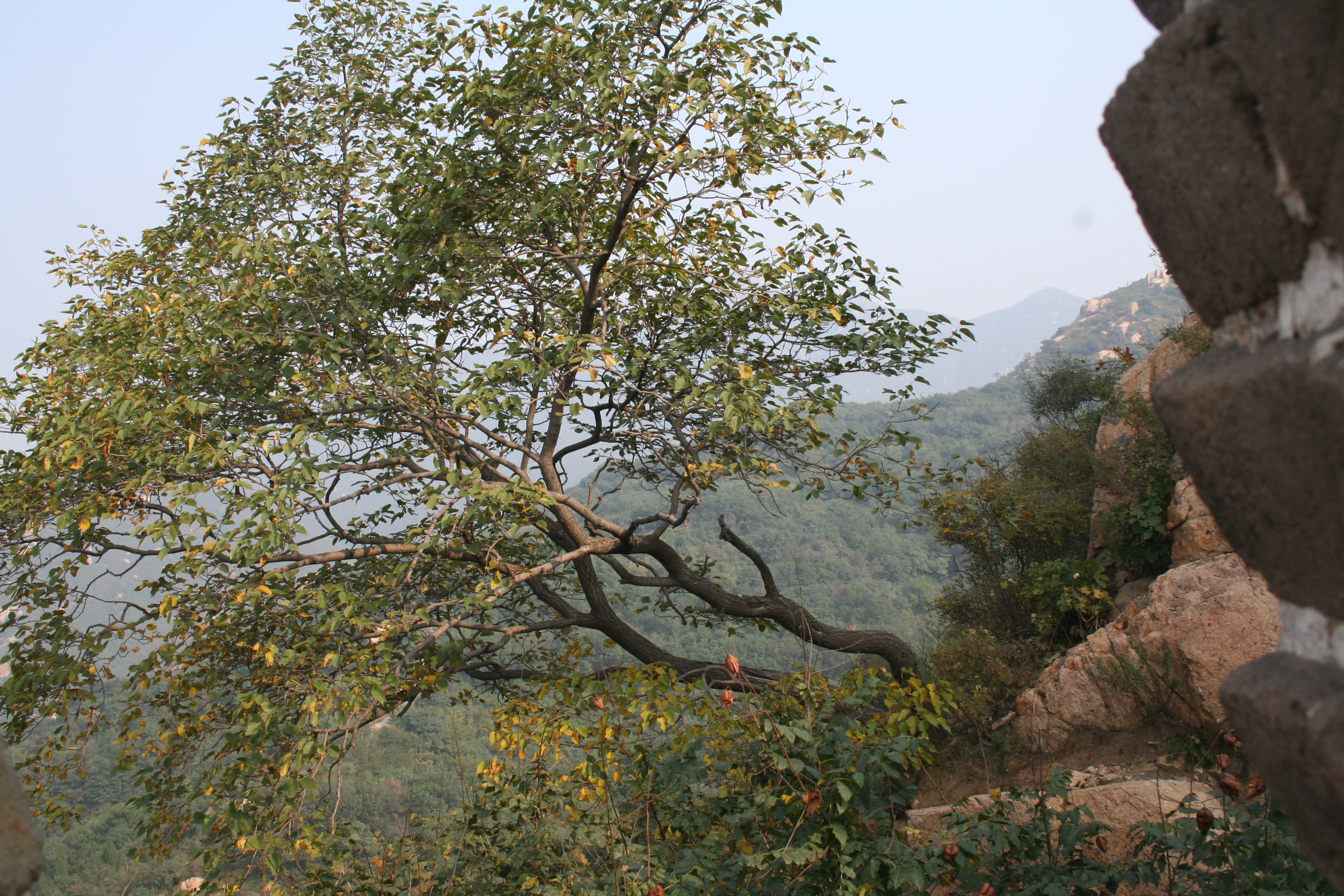
Sideways tree

Sideways Tree. Looking out from the Great Wall of China. Copyright 2006, Mark Sackler

coastline

Costa Rica Coastline. Copyright 2008, Mark Sackler

Loch

A Scottish Loch. Copyright 2010 Mark Sackler

Objection Your Honer, Yanick Lapuh, 1993

Envisioned Solution, Yanick Lapuh, 2006

post

Millennium Conjecture #3: The Future (Part Two)

I Conjecture:  Every Possible Future Exists

Part Two: Quantum Mechanics and The Future

“The best way to predict the future is to invent it.”–Alan Kay

Note: In case you had not surmised it, the most literal title for this conjecture would be “Every Physically Possible Future of Our Universe Exists.”   There is probably not a future in our universe where the laws of physics will change to allow Harry Potter to cast a patronus spell on demontors.

Inventing the quantum future at NASA

Alan Kay’s proposition suggests a philosophical viewpoint that emerges from this conjecture.  But for a better quote to describing its why and wherefore, I harken back to the E.B. White words from Conjecture #2Everything that is not forbidden is mandatory.  It all boils down to Quantum Mechanics.   Many physicists have latched on to this notion;  given enough time, every physically possible combination of matter and energy is bound to occur.  It’s all just a matter of probability.  That said, there are clearly at least two distinct ways of looking at it, depending on which interpretation of quantum mechanics you ascribe to:  Copenhagen or Many Worlds.  Although there are other interpretations, these two have garnered the lions share of advocates in the scientific community, and the notion that every possible future exists can emerge from either one of them.  (See Quantum Weirdness 102 and 103 in this blog for an explanation of both ideas.)

The difference between the two as pertains to the future can easily be stated as virtual vs. actual.  The Many Worlds interpretation asserts that every physical possibility will become an actual reality in an infinitely expanding sea of parallel universes.  Every possible future is, or at least becomes, physically real.  On the other hand, Copenhagen implies that there is no absolute physical reality until the quantum wave function breaks down, that there is only probability on the sub-atomic level until we observe it. From this we can infer that every possible future exists only as a statistical  probability, and only the one we ultimately experience will actually exist.

So what’s the difference?  There isn’t any.  It makes no difference, from the practical experience of entities conscious in a single one of them, whether the futures are real or virtual; we can’t tell the difference.  Every one of those physical realities is still a real possibility.  The good news?   There most certainly is a future out there where you win the lottery!  The bad news?  The only sure way to “invent” that future is to buy every possible number combination.  I don’t recommend quitting your day job.  😦

Up next: The Conjecture of Composite Consciousness.  (Warning: the next couple of conjectures will be quite a bit more radical and original than the those already stated herein.  Actually, I’m warning myself.  Anybody know where I can get some flame retardant garb?)

post

Cosmic Quote #8

“How is it possible to find meaning in a finite world, given my waist and shirt size?”–Woody Allen

(c) 2012 Matthias Giesen. Used by permission. Click image for link.

Physically, I am now back in Connecticut.  Mentally, I am still on vacation in Dubai.  My circadian rhythms?  MIA–but probably floating somewhere north of Saturn and west of Alpha Centauri.  The time difference is 8 hours and we partied way too late every night for old farts of our pre-digital generation.   (We didn’t chose Dubai to vacation, it chose us.  More on that some other time; now back to my day job.)

post

Timeout: This is Not a Pipe

“I am two with nature.”–Woody Allen

This is not a pipe

The Treachery of Images, by Rene Magritte, 1928-29
Ceci n’est pas une pipe. This is not a pipe.

René Magritte’s message is rather unambiguous.  An image of a “thing” is not the thing itself.  But don’t worry, I’m not headed toward a heavy ontological discussion here.  I have a simple question which, believe it or not, my overly opinionated philosophical mind has virtually no idea how to answer.   Maybe one of you out there can help.

I love nature photography.  Flowers, birds, wildlife, oceans, lakes, clouds, mountains, landscapes–you name it, I like looking at these images and they are my favorite to photograph.  Good grief, I’ve even photographed mud puddles and insects.  And yet I am not, by any stretch of the imagination, what one would call a nature lover.  I hate gardening and yard work.  I won’t even mow my own lawn as I am allergic to grass pollen. I haven’t been camping in 30 years and only rarely go hiking.  I do spend a good bit of time outdoors, but this is almost entirely involved with playing or watching sports.  It seems that I prefer a well framed image of nature to the actual experience of nature itself.  And to add to the conundrum, this only applies to photographic images.  My preferences in other visual arts tends towards styles or schools–Surrealist (Miró), Social Realist (Hopper), Post-impressionist (Seurat, Rousseau, Van Gogh), Geometric Abstraction (Klee, Mondrian).  (Here is a link to my favorite contemporary artist, Yanick Lapuh.)

I have only just realized this–and really have no strong ideas about why this should be.  A preference for a well-composed image?  Remnants from a childhood anxiety of physical reality?  Or, like Woody, am I just at two with nature?   All you amateur psychologists please provide your opinions by email, snail mail, or pony express.  (Comments herein are OK, too)

Below, three of my personal favorite landscape photographs from my own travels, as well as a couple of representative pieces by Monsieur Lapuh.

(Click on images for full size)

Sideways tree

Sideways Tree. Looking out from the Great Wall of China. Copyright 2006, Mark Sackler

coastline

Costa Rica Coastline. Copyright 2008, Mark Sackler

Loch

A Scottish Loch. Copyright 2010 Mark Sackler

Objection Your Honer, Yanick Lapuh, 1993

Envisioned Solution, Yanick Lapuh, 2006

post

Conjecture #2: Inevitability (Part 2)

I Conjecture:  In an infinite multiverse we must exist.

Part Two: The impossibility of non-existance

“Needleman was rarely out of public controversy. He published his famous ‘Non-Existence: What To Do If It Suddenly Strikes You’.”–Woody Allen, ‘Remembering Needleman’ (short story)

Image credit: http://www.savagechickens.com (click image for link)

If you think imagining infinity is difficult,  try imagining nothing.  No, I don’t mean blank your mind.  I mean imagine nothingness.  NO!  I don’t mean a vacuum–empty space with no matter and energy.  I mean absolutely nothing:  no space and no time.  I’m betting you can’t do it, even if you think you can; you’re not, even if you think you are.   I merely conjectured that the concept of infinity could not exist in a finite universe, but I am firmly asserting that a conscious entity is incapable of imagining absolute nothingness.  It’s an oxymoron. By the mere fact of imagining you have to imagine something.  And while it might be pure philosophy to suggest it couldn’t be because we are incapable of imagining it, there is strong scientific argument for the “something out of nothing” impossibility of non-existence.  From Hawking on down, physicists have come to the conclusion that there is no such thing as absolute vacuum, that space is full of quantum foam, seething with instability and particles of energy and matter popping in and out of existence.  If matter plus antimatter equals nothing, than by commutation, nothing equals anti-matter plus matter.  (Yes, I know. The intelligent design crowd will reject this and tell us that it is all too perfect.  God must have done it.  Really? So God can exist out of nothing but the universe can’t?  When they can tell me where god came from and offer some form of empirical evidence, I will consider their arguments; but they can’t, so I won’t.)  Final proof: we do exist. Maybe all other arguments are moot.  And anyway I have an out, as the prerequisite for this conjecture is “in an infinite multiverse.”  Let’s rest our neurons for the next installment: The Conjecture of the Future.

(As an entertaining aside, here is a YouTube video of Neal Degrasse Tyson rambling on some cosmic questions.   It includes his conclusion that intelligent life is inevitable.)

post

Timeout: The Sackler Laws (Part 3)

The Law of Laws

“The major difference between a thing that might go wrong and a thing that cannot possibly go wrong is that when a thing that cannot possibly go wrong goes wrong it usually turns out to be impossible to get at and repair.”  Douglas Adams

The only law that works better in practice than it does in theory is Murphy’s Law.

Image Credit: Cartoon Stock.com. Used by permission.

Whomever said originally that Murphy was an optimist was at least hinting at this. But this blog is about cutting to the chase, cutting out the crap, and stating the obvious (or the “should be obvious”) as directly as humanly possible.  After all, it is Einstein who said one should make things as simple as possible.  So for all the countless corollaries, addenda and sub-clauses to the infamous milieu of Murphy,  I do not believe anyone has ever stated this obvious notion so directly.

post

Conjecture #2: Inevitability (Part 1)

I Conjecture:  In an infinite multiverse we must exist.

Part One: Inevitable existance

“Everything not forbidden is compulsory.”–

T.H.White, The Once and Future King

The quote above is from fiction;  in reality is anything but.  It has been echoed by Nobel physics laureate Murray Gell-Mann and effectively, if not literally, by many other scientists.  The message of the random, probabilistic nature of the sub-atomic quantum world is clear:  given enough matter, energy and 4-dimensional space time, anything that is physically possible will eventually happen.  If you roll the dice enough times, you will get every possible result.  If you add an infinite multiverse–and remember, the many worlds interpretation  of the multiverse is only one of four types of postulated multiverse–then it is conceivable that every possible set of physical laws exists somewhere.   To some, this may appear to be just a restatement of the anthropic principle, and they may be right.  Others may say that just the mere fact that we do exist makes this a moot point, and perhaps that could be construed as what I am saying.  Admittedly we are getting down to semantics and philosophy as much as science.

But to reiterate this conjecture flat out,  we exist because it is impossible for us not to.  The justification for this statement is hardly original, and the statement itself has at least been alluded to by philosophers since the ancient Greeks.  Friedrich Nietzsche expounded it as The Eternal Recurrence. It is the notion that, in a Universe that is infinite in either space or time, everything physically possible must recur ad infinitum.   If that is the case, then it follows that it is inevitable that we would exist in the first place and inevitable that we will exist again and again in our current form as well as in every every possible variation.   MIT cosmologist Max Tegmark,  who as stated in a previous post defined the four levels of “other universes” in the multiverse, has taken this concept to an almost bizarre extreme.  He has specifically calculated how far you would have to travel to find another earth with an exact copy of yourself–if and only if our local universe extends infinitely beyond the 13.7 billion light year horizon that we are able to observe.    The number makes the Douglas Adams description of the universe as “mind-bogglingly big” appear to be sub-atomically small.  It is, in light years, a 1 followed by something like a million billion billion zeroes.  I don’t even know how to post that in scientific notation on WordPress. So if our existence is inevitably going to repeat itself in an infinite universe or multiverse, does it not follow that our existence is inevitable in the first place?  No, it does not.  This does not answer the question as to why there is something in the first place, rather than nothing. In part two of this conjecture I will address this question in both scientific and philosophical terms.  And the ultimate answer regarding the impossibility of non-existence will come from the same source as my justification for the conjecture of infinity.

All text in this post ©2012 Mark Sackler