
“It was my biggest blunder.”–Albert Einstein on his cosmological constant concept.
 You have to love ‘ol Albert. It’s not that he admitted he was wrong. It’s that he turned out to be wrong about being wrong. In other words, the cosmological constant turned out not to be such a big blunder after all. He thought that there must be a force in the universe that counteracts gravity and prevents a static universe from contracting on itself. In 1917 he dubbed it the cosmological constant. Then came Hubble’s discovery in the 1920’s that the universe is expanding, which was closely followed by the big bang theory (the actual theory, not the TV show), and out the window went Einstein’s constant. But then, in 1998, it was discovered that the expansion of the universe is accelerating and–bingo!–the cosmological constant, now referred to as dark energy, was reborn.
So what the hell does this have to do with the current equation? It’s also a constant, and it might turn out that it is as slippery and elusive as dark energy. The difference though, is that this one describes contraction, not expansion; more specifically, the contraction of media attention over time as pertains to inane celebrity behavior. I call it:
The Media-illogical Constant
- If you’ve had any physics education, you’ve certainly heard of the inverse square law. It applies to any number of physical properties, gravity, light, radio waves, sound or the attention level of undergraduates to a lecture in a large hall. Simply stated, as one travels away from the source, the intensity of the force or signal decreases by the inverse of the distance squared. A similar equation can describe the rate at which our tabloid-minded western media lose interest in stupid celebrity hijinks. The equation is the same as the inverse square law with one modification: just substitute time for distance. Quite simply, it looks like this:
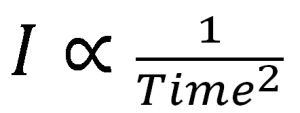 In plain English: the intensity of the media attention is proportionate to the inverse of the time since the story’s emergence to national (or international) attention, squared. So when Lindsay Lohan gets arrested–yet again–the media attention four days after the story will be 1/16th of what it was when the story broke. [Are you are wondering why this equation just doesn’t use an equal sign instead of a proportional to sign? It beats me. But one immutable rule of these posts is to always use the coolest looking symbol possible.]
- .
- There are, of course, caveats–aren’t there always? This theoretical pronouncement exactly works, if, and only if, there is no significant obstruction or interference from other media events, whether or not they involve inane celebrities. This is the same as applies to physical properties measured with the inverse square law. Place a brick wall between the light source and your measuring device and all bets are off. Likewise, a bigger story may come along and completely drown out whatever Lady Gaga has been up to lately. I have a name for this phenomenon and resulting calculations–pretty cheeky of me since I haven’t even invented it yet. I call it The Big Bust Theory. Depending on the stories involved, this may or may not be a double entendre. Either way, part two of this post will deal with that equation. It’s coming soon to a blogoshere near you.










 The Millennium Conjectures™