post

Quantum Weirdness 105, Review: How to teach Quantum Physics to Your Dog

        “I have a very good nose. I can sniff into extra dimensions. They’re full of evil squirrels. With goatees.”–

Chad Orzel’s dog, in How to Teach Quantum Physics to Your Dog.

Chad Orzel is my kind of guy.  If it wasn’t for the fact that How to Teach Quantum Physics to Your Dog was copyrighted in 2010, I would have sworn he had read my Law of Canine Chaos before writing the following.

Sound waves are pressure in the air.  When a dog barks, she forces air out through her mouth and sets up a vibrations that travel through the air in all directions.  When it reaches another dog, that sound wave cause vibrations in the second dog’s eardrums, which are turned into signals in the brain that are processed as sound, causing the second dog to bark,  producing more waves, until nearby humans get annoyed.  [emphasis mine]

Amen, brother.

But the point is, he explains and summarizes beautifully–and expands upon lucidly–all the points in my first four Quantum Weirdness posts.  He does so in a manner clear enough that, if you can’t understand it, at least your dog will.  Maybe the pooch can then explain it to you. Either way,  I recommend it highly.  Unfortunately, though,it seems to be out of print in the US.   It is available, mostly from the UK, from various resellers on ebay and barnesandnoble.com.  Orzel has also written How to Teach Relativity to Your Dog and How to Teach Physics to Your Dog.  Before you know it, those clever mutts will be running the LHC at CERN.  I doubt they will be looking for the Higgs Boson, though.
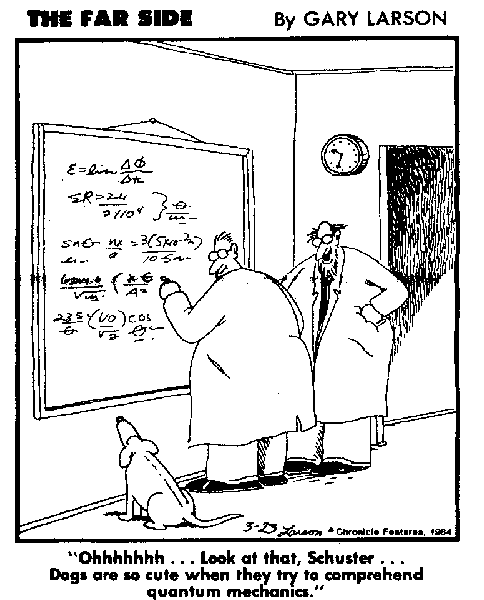
Copyright 1984, Chronicle Features

post

Millennium Conjecture #3: The Future (Part Two)

I Conjecture:  Every Possible Future Exists

Part Two: Quantum Mechanics and The Future

“The best way to predict the future is to invent it.”–Alan Kay

Note: In case you had not surmised it, the most literal title for this conjecture would be “Every Physically Possible Future of Our Universe Exists.”   There is probably not a future in our universe where the laws of physics will change to allow Harry Potter to cast a patronus spell on demontors.

Inventing the quantum future at NASA

Alan Kay’s proposition suggests a philosophical viewpoint that emerges from this conjecture.  But for a better quote to describing its why and wherefore, I harken back to the E.B. White words from Conjecture #2Everything that is not forbidden is mandatory.  It all boils down to Quantum Mechanics.   Many physicists have latched on to this notion;  given enough time, every physically possible combination of matter and energy is bound to occur.  It’s all just a matter of probability.  That said, there are clearly at least two distinct ways of looking at it, depending on which interpretation of quantum mechanics you ascribe to:  Copenhagen or Many Worlds.  Although there are other interpretations, these two have garnered the lions share of advocates in the scientific community, and the notion that every possible future exists can emerge from either one of them.  (See Quantum Weirdness 102 and 103 in this blog for an explanation of both ideas.)

The difference between the two as pertains to the future can easily be stated as virtual vs. actual.  The Many Worlds interpretation asserts that every physical possibility will become an actual reality in an infinitely expanding sea of parallel universes.  Every possible future is, or at least becomes, physically real.  On the other hand, Copenhagen implies that there is no absolute physical reality until the quantum wave function breaks down, that there is only probability on the sub-atomic level until we observe it. From this we can infer that every possible future exists only as a statistical  probability, and only the one we ultimately experience will actually exist.

So what’s the difference?  There isn’t any.  It makes no difference, from the practical experience of entities conscious in a single one of them, whether the futures are real or virtual; we can’t tell the difference.  Every one of those physical realities is still a real possibility.  The good news?   There most certainly is a future out there where you win the lottery!  The bad news?  The only sure way to “invent” that future is to buy every possible number combination.  I don’t recommend quitting your day job.  😦

Up next: The Conjecture of Composite Consciousness.  (Warning: the next couple of conjectures will be quite a bit more radical and original than the those already stated herein.  Actually, I’m warning myself.  Anybody know where I can get some flame retardant garb?)

post

Conjecture #3: The Future (Part One)

I Conjecture:  Every Possible Future Exists

Part One: The Post-Newtonian Wordview

“The Future ain’t what it used to be.”–Yogi Berra

Yogi

Yogi, philosopher extraordinaire, deep in thought

Yogi was right. Literally.

He had absolutely no idea what he was talking about, but he was right nonetheless.  For the way we view the future is directly related to how we view physical reality. Ergo, as our understanding of physical reality changes, so changes how we think about the future.   An entire graduate level lecture could probably be based on this conjecture.  I’ll condense the basic idea to a few paragraphs.

Before Apple, the company, there was apple, the fruit.  And before that fateful day when one of those red orbs conked one Isaac Newton on the noggin, worldviews were simplistic and not generally  based on science.   They were mostly mystical or religious.  Supernatural forces ruled the world and what they had in store for mankind was up to them; it was not to be known by us.  But when the soon-to-be “Sir” Isaac set forth his rules of motion and gravity classical physics was born.  Every action had an equal and opposite reaction, every force and its interaction with mass was theoretically calculable, and therefore predictable.  Newton’s laws ruled physics, and indeed, most science based worldviews for nearly 250 years.

Then two guys named Einstein and Planck came along and screwed up the whole thing.  They were followed by the likes of Heisenberg and Bohr and Schrodinger, who threw the monkey wrenches of quantum mechanics, and most disturbingly, quantum uncertainty, into the mechanisms of physics.  Nothing was ever the same again.**

Just how did these 20th century scientific revolutions, along with chaos and complexity theories, alter the Newtonian worldview?

The Newtonian worldview was deterministic, the post-Newtonian worldview is not.  It was theorized, under Newton’s classical laws, that if one could know the position and momentum of every particle of matter and energy in the universe, then one could know everything that has ever happened and could predict everything that ever would happen in the future.   Quantum mechanics and uncertainty skewered that notion; it killed it stone dead.  As explained in my Quantum Weirdness primers, it is not possible to simultaneously know the exact position and momentum of quantum objects, and interactions of quanta with their environment are only calculable as probabilities. 

In other words, the Newtonian worldview asserted that we could calculate exactly where any particle of matter or energy would be at any time.  The post-Newtonian worldview states that we can only calculate the probability of finding it in a given position at a given time.  The disconcerting part of that last statement is the “finding” part.  For it asserts exactly that, the probability of finding it if we look for it; it does not predict where it is, for until we look it is effectively in every possible position at once.

How does this affect our view of the future and my conjecture that every possible future exists?  In the Newtonian worldview, there is no free will; everything is determined by the existing state of the universe and there is therefore only one possible future.  That would be the one that follows from applying Newton’s laws to the current state of every bit of matter and energy in the universe.  But in the post-Newtonian world, those rules do not work on a quantum level.  Position and momentum are uncertain and results of interactions can only be stated as probabilities.  In a non-deterministic world, free will is enabled and the totality of the future is unpredictable no matter how much data we have to crunch.

Does this future exist?

OK.  Many futures are possible.  But how can I assert that every possible future exists?   I’ll take that up in Part Two of this conjecture.

**It should be noted that while Albert  Einstein, along with Max Planck, laid the foundations of quantum mechanics, he never believed its predictions of uncertainty and randomness.  Perhaps his most famous quotation, “god does not play dice,” refers to this very matter.  He spent much of the last thirty years of his life attempting to find a deeper meaning–hidden variables–that would give the lie to these notions.  He failed and was ultimately proven wrong.  More about this in a future conjecture.

post

Quantum Weirdness 104: Heisenberg’s Uncertainty

“Doubt is unpleasant, but certainty is ridiculous.”–Voltaire

Heisenberg may be dead, but his uncertainty principal is alive and kicking.
(Image credit unknown)

It was the end of the Newtonian worldview.   Early in the 20th century relativity and quantum mechanics created a new scientific outlook on reality–counter-intuitive and downright….well…weird.  The final nail in the coffin of so-called Newtonian determinism was put forth by one Werner Heisenberg in 1927: the uncertainty principle.   Simply stated, you can’t exactly know both the momentum and location of a quantum object.  The more precisely you know one, the less precisely you know the other.   And while recent news headlines suggest to some that Heisenberg has been overturned, this is absolutely NOT the case.   It was thought that the very act of measuring a quantum particle added to the uncertainty, but that was never really part of Heisenberg’s equation–which in fact can also apply to macroscopic phenomena like sound and water waves.  So while a team from the University of Toronto was able to devise a means to measure a quanta (such as an electron or photon) with minimal increase in uncertainty, even they admitted “the quantum world is still full of uncertainty, but at least our attempts to look at it don’t have to add as much uncertainty as we used to think!”

Heisenberg’s principle plays a critical role in something that is rather significant in the foundations of modern philosophy, and as I see it, civilization itself.  That would be how we view the future.  This will be explained in the next conjecture.

Here is a simple video demonstration of the concept by Walter Lewin of MIT–a single-slit experiment.

If you’re brave enough to tackle the math, here is a link to another video from Mind Bites that explains it in terms so simple even I can understand it.  Er…maybe.

post

Vacation Rerun: Quantum Weirdness 102, Equal Time for the Cat

Where’s Waldo?

By the time this post goes winging outward to the vastness of cyberspace,  Cheryl and I will be winging our way home from distant parts unknown. The next new post will return to the subject matter below, so bone up and be ready for brain cramps.

“I don’t like it, and I’m sorry I ever had anything to do with it.”
Erwin Schrödinger  (referring to Quantum Mechanics).

What better follow up to The Equation of Canine Chaos, then the infamous tale of Schrodinger’s Cat?

In Quantum Weirdness 101, we saw that the double-slit experiment revealed the wave-particle duality of sub-atomic quanta, and the fact that these troublesome little bits behave as if they are everywhere they could possibly be at once until an observer looks for them.  While the experimental proof that this happens is rock-solid, the explanation for what causes it is anything but.  For decades after its original discovery in the 1920’s, the predominant interpretation—essentially, in fact, the only one—was the so-called Copenhagen Interpretation.  It essentially states that the universe is just fuzzy on the sub-atomic level, it doesn’t affect our everyday macro-world, and we mortals should not worry about it otherwise.  Critics have said it is really no interpretation, and some facetiously call it the “shut-up-and-calculate” interpretation.   In 1935, Erwin Schrodinger posed perhaps the most famous mind experiment in all of physics to show that theoretically the Copenhagen Interpretation makes no sense.  More recently, physicists have been able to succeed in creating this quantum superposition with larger and larger bits of matter, which tends to shoot empirical holes in Copenhagen.

Anyway, this witty video does a good job of explaining the concept behind Schrodinger’s Cat.  And I’m pretty sure that no cats were harmed in its making—much to the chagrin of my dogs.

(Video Credit: Open University, on You Tube)

post

Conjecture #2: Inevitability (Part 2)

I Conjecture:  In an infinite multiverse we must exist.

Part Two: The impossibility of non-existance

“Needleman was rarely out of public controversy. He published his famous ‘Non-Existence: What To Do If It Suddenly Strikes You’.”–Woody Allen, ‘Remembering Needleman’ (short story)

Image credit: http://www.savagechickens.com (click image for link)

If you think imagining infinity is difficult,  try imagining nothing.  No, I don’t mean blank your mind.  I mean imagine nothingness.  NO!  I don’t mean a vacuum–empty space with no matter and energy.  I mean absolutely nothing:  no space and no time.  I’m betting you can’t do it, even if you think you can; you’re not, even if you think you are.   I merely conjectured that the concept of infinity could not exist in a finite universe, but I am firmly asserting that a conscious entity is incapable of imagining absolute nothingness.  It’s an oxymoron. By the mere fact of imagining you have to imagine something.  And while it might be pure philosophy to suggest it couldn’t be because we are incapable of imagining it, there is strong scientific argument for the “something out of nothing” impossibility of non-existence.  From Hawking on down, physicists have come to the conclusion that there is no such thing as absolute vacuum, that space is full of quantum foam, seething with instability and particles of energy and matter popping in and out of existence.  If matter plus antimatter equals nothing, than by commutation, nothing equals anti-matter plus matter.  (Yes, I know. The intelligent design crowd will reject this and tell us that it is all too perfect.  God must have done it.  Really? So God can exist out of nothing but the universe can’t?  When they can tell me where god came from and offer some form of empirical evidence, I will consider their arguments; but they can’t, so I won’t.)  Final proof: we do exist. Maybe all other arguments are moot.  And anyway I have an out, as the prerequisite for this conjecture is “in an infinite multiverse.”  Let’s rest our neurons for the next installment: The Conjecture of the Future.

(As an entertaining aside, here is a YouTube video of Neal Degrasse Tyson rambling on some cosmic questions.   It includes his conclusion that intelligent life is inevitable.)

post

Conjecture #2: Inevitability (Part 1)

I Conjecture:  In an infinite multiverse we must exist.

Part One: Inevitable existance

“Everything not forbidden is compulsory.”–

T.H.White, The Once and Future King

The quote above is from fiction;  in reality is anything but.  It has been echoed by Nobel physics laureate Murray Gell-Mann and effectively, if not literally, by many other scientists.  The message of the random, probabilistic nature of the sub-atomic quantum world is clear:  given enough matter, energy and 4-dimensional space time, anything that is physically possible will eventually happen.  If you roll the dice enough times, you will get every possible result.  If you add an infinite multiverse–and remember, the many worlds interpretation  of the multiverse is only one of four types of postulated multiverse–then it is conceivable that every possible set of physical laws exists somewhere.   To some, this may appear to be just a restatement of the anthropic principle, and they may be right.  Others may say that just the mere fact that we do exist makes this a moot point, and perhaps that could be construed as what I am saying.  Admittedly we are getting down to semantics and philosophy as much as science.

But to reiterate this conjecture flat out,  we exist because it is impossible for us not to.  The justification for this statement is hardly original, and the statement itself has at least been alluded to by philosophers since the ancient Greeks.  Friedrich Nietzsche expounded it as The Eternal Recurrence. It is the notion that, in a Universe that is infinite in either space or time, everything physically possible must recur ad infinitum.   If that is the case, then it follows that it is inevitable that we would exist in the first place and inevitable that we will exist again and again in our current form as well as in every every possible variation.   MIT cosmologist Max Tegmark,  who as stated in a previous post defined the four levels of “other universes” in the multiverse, has taken this concept to an almost bizarre extreme.  He has specifically calculated how far you would have to travel to find another earth with an exact copy of yourself–if and only if our local universe extends infinitely beyond the 13.7 billion light year horizon that we are able to observe.    The number makes the Douglas Adams description of the universe as “mind-bogglingly big” appear to be sub-atomically small.  It is, in light years, a 1 followed by something like a million billion billion zeroes.  I don’t even know how to post that in scientific notation on WordPress. So if our existence is inevitably going to repeat itself in an infinite universe or multiverse, does it not follow that our existence is inevitable in the first place?  No, it does not.  This does not answer the question as to why there is something in the first place, rather than nothing. In part two of this conjecture I will address this question in both scientific and philosophical terms.  And the ultimate answer regarding the impossibility of non-existence will come from the same source as my justification for the conjecture of infinity.

All text in this post ©2012 Mark Sackler

post

Quantum Weirdness 103: How Many Worlds?

“There is no question that there is an unseen world. The problem is, how far is it from midtown and how late is it open?” –Woody Allen

For the quantum physics-uninitiated, get ready for the weirdest of the weird: the many worlds interpretation of quantum mechanics.

In Quantum Weirdness 101, we talked about the wave-particle duality of sub-atomic quanta, and how they appear to be in a superposition of every possible trajectory and location until an observer measures them.

In Quantum Weirdness 102, we discussed The Copenhagen Interpretation, which basically states that reality is just fuzzy on that level.  They are only potential trajectories–probabilities–interfering with each other, and this doesn’t have a measurable effect on our everyday macro world.   But we also visited Schrödinger’s infamous cat–the mind experiment that poked a colossal hole in  Copenhagen.

Image Credit: University of Oregon, 21st Century Science

The Copenhagen interpretation remained the most popular explanation for decades, in spite of Schrödinger.   But in 1957 cosmologist Hugh Everett made an astonishing proposal.  He suggested that the particles themselves–not merely their probabilities–interfere with one-another.  In this interpretation, they actually take every possible trajectory, each in an alternate universe.  Effectively every physically possible history exists in a huge–possibly infinite–number of alternate universes. So when we look in the box containing that possibly dead or alive cat it is actually in two universes: alive in one, dead in the other.   We just see it in the one we are in.   Taken to the extreme, every one of us would exist in a countless number of alternate universes.   Some would be imperceptibly different from ours, in others we might not even recognize ourselves or the the world around us.  And while Everett was mostly ignored or derided in his day, his many worlds interpretation has become a leading explanation of quantum weirdness, rivaling even Copenhagen.

So where do I stand?  Agnostic.  It is a rather optimistic world view.  I hope it’s true; I’m afraid it isn’t.  But many of the world’s top physicists now lean towards many worlds, and David Deutsch, among others, makes some very convincing arguments using deductive reasoning if not direct evidence.  I will leave it at this: it is a strong possibility that greatly influences my millennium conjectures. For more detailed background, check out the Wikipedia articles on The Many Worlds interpretation,  as well as general overview of quantum mechanics interpretations.   Or if you prefer, here is an entertaining video, shamelessly lifted from YouTube.