post

Conjecture #1: Infinity (Part 3)

I Conjecture:  The Concept of Infinity Could not Exist in a Finite Universe.

Part Three: Human Imagination

“Two things are infinite: the universe and human stupidity; and I’m not sure about the universe.”
Albert Einstein

It is certainly understandable how somebody as brilliant as Einstein could perceive the rest of us to be infinitely stupid.  Jokes about lawyers and politicians aside, I’m not sure about either.  I remain an agnostic on untestable scientific conjectures,  as well as on religion.  But my gut continues to tell me that my conjecture of infinity has merit, so I’ll proffer one final discussion before moving on to the next one.

Nothing is inherently more self-contradictory than infinity.  We can imagine it mathematically, but can’t measure it.  We can imagine–sort of–infinite time and space.  But physicists and philosophers tell us there are a finite number of possible combinations of matter and energy, at least in our observable universe with our laws of physics.  But we can imagine things beyond those laws (fantasies like Harry Potter, various science fiction scenarios,  and possibly real alternate universes with different laws of physics, to name just a few).  So our imagination does not seem to be limited by what is possible or observable in nature.  By that it would be reasonable to assume that human creativity and human stupidity are both potentially infinite.**

One of my favorite quotes about the universe is the famous J.B.S. Haldane proposition, “I suppose the universe is not only queerer (sic) then we imagine, it is queerer than we can imagine.”  This would seem to be a contradiction of the notion that human imagination is infinite.  David Deutsch says as much in The Beginning of Infinity, and he says so specifically in regard to this quote.  His point is that human imagination and creativity are potentially infinite and that Haldane is, therefore, wrong.  But where infinity is concerned, even Deutsch contradicts himself.  For as he points out elsewhere in the book,  there are mutually exclusive infinities and there are also larger and smaller infinities.  Consider the set of all even integers and the set of all odd integers.  They are mutually exclusive yet both infinite.  Now consider the set of all even integers and the set of all integers.  They are both infinite, yet the latter is twice as large as the former.  The point is: there might be both an infinity of things we can imagine, and an infinity of things we can’t imagine.   Deutsch himself indirectly alludes to this in his earlier book, The Fabric of Reality.

There is no question that the Haldane quote was true at least in the early part of the 20th century when he first espoused it.   The universe certainly turned out to be stranger than anyone could imagine at that time.  But the universe continues to surprise us, no matter what we imagine.  And if our imagination is only potentially infinite we cannot imagine, at any one time, everything that exists or the larger infinity that might exist.   To me, this is what makes the combination of human imagination with empirical knowledge so exciting.  No matter what we can test or what we can imagine, there are still surprises out there to delight and confound us.  But in my final analysis–the one that needs explanations and not just measurement–Einstein was absolutely right in another of his famous quotes:

“Imagination is more important than knowledge.”

Up next (after a few digressions and ridiculous timeouts): The conjecture of inevitability

**By potentially unlimited here, I mean no theoretical limit.  To be actually infinite, humanity would have to exist forever.

post

Quantum Weirdness 102: Equal Time for the Cat

“I don’t like it, and I’m sorry I ever had anything to do with it.”
Erwin Schrödinger  (referring to Quantum Mechanics).

What better follow up to The Equation of Canine Chaos, then the infamous tale of Schrodinger’s Cat?

In Quantum Weirdness 101, we saw that the double-slit experiment revealed the wave-particle duality of sub-atomic quanta, and the fact that these troublesome little bits behave as if they are everywhere they could possibly be at once until an observer looks for them.  While the experimental proof that this happens is rock-solid, the explanation for what causes it is anything but.  For decades after its original discovery in the 1920’s, the predominant interpretation—essentially, in fact, the only one—was the so-called Copenhagen Interpretation.  It essentially states that the universe is just fuzzy on the sub-atomic level, it doesn’t affect our everyday macro-world, and we mortals should not worry about it otherwise.  Critics have said it is really no interpretation, and some facetiously call it the “shut-up-and-calculate” interpretation.   In 1935, Erwin Schrodinger posed perhaps the most famous mind experiment in all of physics to show that theoretically the Copenhagen Interpretation makes no sense.  More recently, physicists have been able to succeed in creating this quantum superposition with larger and larger bits of matter, which tends to shoot empirical holes in Copenhagen.

Anyway, this witty video does a good job of explaining the concept behind Schrodinger’s Cat.  And I’m pretty sure that no cats were harmed in its making—much to the chagrin of my dogs.

In the next installment: the many worlds interpretation of quantum weirdness.

post

Remembering My Dad

Remembering My Dad

Albert Allen Sackler
October 8, 1919-April 27,2012

The word serendipity usually conjures up images of inventors or scientists shouting “eureka” when they stumble upon some unexpected discovery.  But serendipity–the so-called happy accident–has its place in art and life as well. On this first father’s day without my beloved dad, here is a story of fond remembrance that might make you smile.

It was the fall of 1967 and my father had just installed some custom cabinetry in our large family den.  It was state of the art for the era: bookshelves, bar and a media center with a stereo and a color TV, the latter which he assembled himself from a Heathkit.  He was, after all, an electrical engineer.  What he never was, before or since, was an artist.  But he was about to become one for just a brief shining moment.

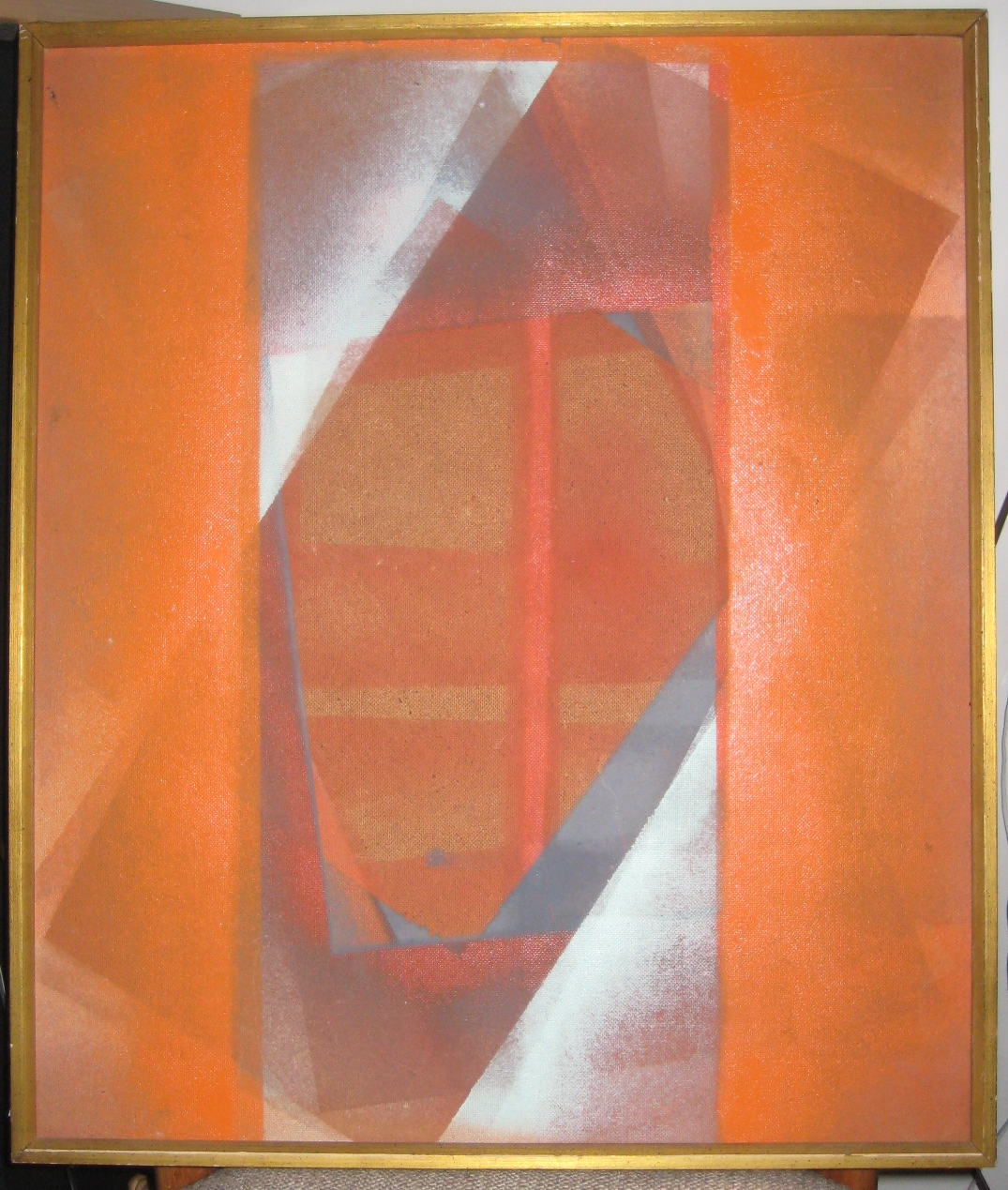
Overspray #1

The bar consisted of a fold down counter which revealed the spirits in the compartment behind it, and above it a cabinet with doors for glassware.  The doors had clear plexiglass window panels, which somehow did not suit my mother’s taste.  My father dutifully removed them to the basement, where he proceeded to spray paint them bright, solid colors.  He replaced the panels, and was prepared to discard the plywood square that had been the drop cloth for the paint job.   But our neighbor, physician and author Jack Shiller, just happened to stop by and call a halt to the demolition.

“Don’t throw that out!”  Dr. Shiller exclaimed

“Huh?”

“Put a frame around it!”

He did.  And he entered it in a local art show.   And it won an honorable mention prize; boy, were the judges pissed when they found out the story behind it.

Serendipity or not, I’m glad he was my dad and will love him forever.

Happy Father’s Day to all.

video

Quantum Weirdness 101:  The Double-Slit Experiment

“Anyone who is not shocked by quantum theory has not understood it.”–

Neils Bohr

With apologies to Douglas Adams–don’t panic!  Although an understanding of a few basic concepts of quantum mechanics will be helpful in following some of the Millennium Conjectures, it’s actually not that hard to grasp.  No math is needed.  The following video gives a clear and entertaining description of the wave-particle duality of the sub-atomic world.   If you weren’t already familiar with the concept, this should give you what you need to “get it.”   What it won’t allow you to do is come to grips with it, or even believe it.  But you’d better believe it.  Quantum theory is one of the most rock solid, experimentally verified fields in all of science.   And whether you believe it or not, don’t even think of explaining it.  The world’s most brilliant physicists have been debating the implications for decades and are nowhere near a consensus.   If you’d like a little more after the video, including a description of some of the leading explanations, here is a text primer.


post

Conjecture #1: Infinity (Part One)

 I conjecture:  The concept of infinity could not exist in a finite universe.

“I am incapable of conceiving infinity, and yet I do not accept finity.”

 Simone de Beauvoir

.

Pure philosophy?  It might be.  It’s probably not provable in any scientific manner; but it’s certainly conjecturable.  So let’s discuss the implications, as many of the Millennium Conjectures to come herein presume the universe—or multiverse, if you please—to be infinite in some shape or form.  As most religions require a belief in god as a given, my worldview based on science needs to take a stand on infinity.

As best as can be determined, the ancient Greeks seem to have invented the mathematical concept of infinity.  (Okay—with the possible exceptions of baseball, hot dogs, apple pie and Chevrolet—what didn’t the ancient Greeks think of first?)  So the question begs, did we humans discover infinity or did we invent it?  It’s certainly conceivable that we could have invented it, at least in the mathematical sense.  Let’s look briefly at two other possible dimensions of infinity—time and space.  Of course, Einstein asserted that time and space are a single four-dimensional continuum, but let’s separate the two for the purposes of this metaphysical discussion.

The Possibility of Infinite Time

In 1949, using Einstein’s equations of general relativity, Kurt Gödel provided a proof  that a certain type of rotating universe would be static and spatially finite, but temporally infinite in a rather unnerving form: it would contain closed time loops that would permit time-travel into the past. While evident that it did not exactly describe our universe, which is indeed expanding, Einstein himself admitted it raised disturbing questions about the nature of time in our universe.  Gödel later expressed a philosophical argument that this  proof suggests that time in our own universe does not exist, either as Einstein described it or as we intuitively experience it.1

Kurt Gödel

More recently, philosopher-scientist Julian Barbour has taken complete issue with Einstein suggesting that time is an illusion created by change–that it in fact does not exist at all.  He asserts that time does not flow, but is a series of distinct, static and timeless instants that we experience as “flowing” time.2      David Deutsch, took this once step further in his book The Fabric of Reality, when he asserted that time not only does not flow, but each  instant we experience represents an alternate universe, each deterministic.  He essentially argues that our consciousness moves  from alternate universe to alternate universe and that it is this which is the source of perceived in-determinism and free will.  [For now, don’t worry about the “many worlds” interpretation of quantum mechanics if you don’t understand it.  I’ll provide some simple primers on these concepts in “asides” between the main posts.]

So let’s leave it at this: nobody really knows for sure exactly what time is, or if it even exists in anything like the form in which we experience it.  So let’s move on.  Next up is a discussion of space as a possible “infinite” dimension of reality.  And don’t worry–there will be some intervening silliness if only for comic relief.

Notes:

  1.  Gödel universe, The Encyclopedia of Science (online)
  2. Barbour, Julian, The End of Time: The Next Revolution in Physics (1999) Oxford University Press p.9
  3. Deutsch, David, The Fabric of Reality (1997) Penguin Books,  Chapter 11, Time: the First Quantum Concept, pp. 259-288.
post

Introducing The Millenium Conjectures

“..in reality, scientific theories are not ‘derived’ from anything.  They are guesses—bold conjectures.”

David Deutsch, The Beginning of Infinity


David Deutsch

In his provocative and stimulating tome The Beginning of Infinity, the British astrophysicist David Deutsch describes the role of science as one not so much as describing reality as explaining it.  It does this, he asserts, through conjectures which then may be tested by experiment.   But this leaves substantial problems in today’s complex and technical world, as there are many conjectures about reality which we cannot test, or at least, cannot test yet.  The existence of exo-planets—planetary systems around stars other than our sun—was only a conjecture until the technology existed to actually detect such bodies. Many mathematical conjectures were not provable for centuries until the advent of sufficient computing power to do so.  Many other scientific ideas—from simple speculations to profound interpretations—cannot be tested with today’s technologies; in some cases, we cannot even imagine how ever to test them.  The “many worlds” interpretation of quantum mechanics is one of these.   This is a subject I will deal with specifically in a later post.  But the point is: my concern here is with ideas we cannot yet, or maybe never can prove.

Edge.org

Why bother?  One of the most interesting books I have ever read is the 2005 volume What We Believe but Cannot Prove. Published by edge.org,one reviewer expressed its content quite succinctly:

John Brockman, writer, publisher and events manager for the science elite, has asked a hundred researchers the question, What do you believe is true even though you cannot prove it? The answers are posted at his e-magazine Edge (www.edge.org), and they exert an unquestionable morbid fascination—those are the very ideas that scientists cannot confess in their technical papers.  –JAVIER SAMPEDRO, Madrid,  EL PAIS, February 20, 2005

We all need a worldview.  And while some scientists and philosophers may simply say, “that’s just the way it is, no explanation is needed,” I cannot live with that.  My worldview is based on science, but it needs explanations.

I do not pretend to have any answers.  I don’t even have the viewpoint of a trained scientist.   My viewpoint is the journalistic approach of a layman generalist with a passion for science.  These are, in effect, my own interpretations of what I have read and learned about the present state of human knowledge of physical reality.  In some cases, I may be simply re-stating in my own terms, with my own views of the implications, ideas that may have been put forth or at least hinted at by others. Most of these subjects will involve issues we can’t really test now—maybe never.  I for one need a way of viewing reality that is based on science, but goes beyond what we can absolutely test.  I require explanations, but untestable explanations must seem at least scientifically feasible.  I cannot brook the mystical or supernatural—and yes, in some respects, the religious.  I am a non-theistic existentialist, and this is how I build my world view based on science.

So these are my conjectures.  They are indeed bold guesses.  They are not intended to be absolute assertions of reality—anything but.  They are my suggestions of things that might be true, that I imagine could be true, but that in many cases may not even be provable one way or the other.  What I am doing is asking: what are the implications of this viewpoint?  These are—essentially—what ifs.

UP NEXT:   #1 The Conjecture of Infinity

Text in this post ©2012 Mark Sackler

Suggested reading:

post

What is this?

These are my musings, both ridiculous and sublime.  I would have made “Ridiculous and Sublime” the primary title of this blog, but I am vain.  I want some semblance of uniqueness and there are many other bloggers using this theme.   But I will explain both title and subtitle before proceeding.

So what are Millennium Conjectures?  I’ll explain that in a bit as well.  But first, I present a word about the overall content and nature of my posts.  And why I, and my posts, are both ridiculous and sublime.

This is not a personal journal.  Who would be interested in reading my personal journal online?  I wouldn’t even be interested.  No, these are musings, observations and conjectures from a journalistic standpoint, a way of looking at things you might find interesting or funny.  You might also find some silly and trivial.  I do have some past background in both broadcast and print journalism, but that is not my professional livelihood these days; I do this for the satisfaction and outlet.

So—I’ll get back to the subtitle.

Let’s face it: I am both ridiculous and sublime.  To start with, the two most famous people whose birthday I share (October 2) are Mohandas Gandhi and Groucho Marx.

Gandhi

What could be more sublime and ridiculous than those two?  And to boot, the most famous thing, arguably, that happened on the very day of my birth (Oct 2, 1950), was the appearance of the very first syndicated Peanuts cartoon.  Good ‘ol Charlie Brown was born the same day as me.  He is most certainly a perfect blending of the two qualities we are talking about.  Wishy-washy? Maybe. But that is only because he is so torn by these conflicting aspects of the universe that surrounds him.  Yes, the silly and profound seem both to be bound into my DNA.

Content herein will then consist of both the trivial/silly (WheresGeorge.com, history of CT license plates, Pearls Before Swine) and the profound (Quantum Physics, Cosmology, Existentialism, Opera and the philosophy of science).  There will also be topics that engender a bit of both characteristics; baseball, for example, and especially baseball statistics.  Yes, Baseball is a game, but as George Will so astutely observed, “if baseball is just a game, then the Grand Canyon is just a hole in the ground.”   This will happen solely because my cluttered mind embraces all of these endeavors, and for some strange reason, I think that somewhere out there one or two people might be interested in my insights.

So, back to the Millenium Conjectures.  My posts will be marked as either Ridiculous or Sublime or Ridiculous AND Sublime.  The lion’s share of the Sublime category—indeed of all the content– will be a series I call The Millenium Conjectures.  These will deal with my views and speculations on the nature of reality, the universe and  scientific philosophy.  Everything else will be a time-out to blow off steam. But lest my head explode, let alone yours, this is enough for now.                                                   Text in this post ©2012 Mark Sackler